We live in an age of dashboards, surveys, databases and performance indicators. Governments count residents to plan services. Businesses analyse transactions to understand cash flow. Churches record membership and attendance. Nonprofit organisations report beneficiaries and outcomes to funders.
Yet the questions behind all this technology are ancient: Who should be counted? For what purpose? Who is responsible for the record? What will the numbers be used to decide? And who might be overlooked?
The biblical Book of Numbers offers a surprisingly rich setting for exploring those questions. Its Hebrew title, Bemidbar—“in the wilderness”—reminds us that this is first a story of Israel's life with God, not a modern textbook on statistics. Still, within that story, we find censuses, named officials, family registers, work assignments, inventories, contribution records, field reports, land-allocation rules and a written itinerary.
The point is not to claim that Moses invented data science. The stronger insight is this:
Information becomes valuable when it serves a clear purpose, can be interpreted responsibly and leads to faithful action.
Numbers shows both the usefulness of records and the danger of treating a count as the whole truth.
1. Begin with the question, not the spreadsheet — Numbers 1
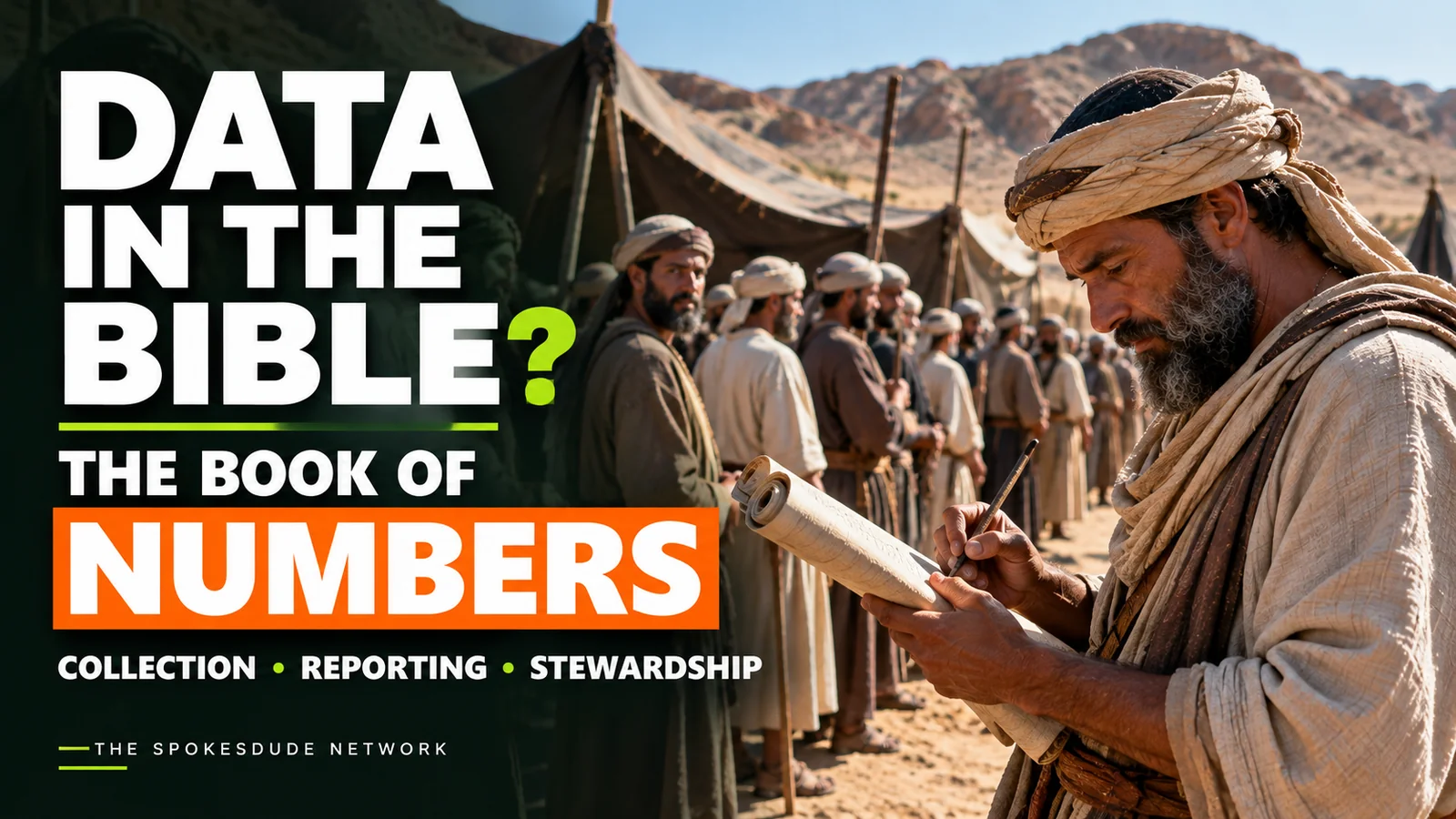
At Sinai, the Lord instructs Moses and Aaron to count men aged twenty and above who are eligible for Israel's military service, arranged by tribe, clan and family. A leader from each tribe participates in the process (Numbers 1:1–19).
Notice the structure. The exercise has a purpose (organisation for service), a defined population (military-eligible men aged twenty and older), categories (tribe and household), responsible collectors (Moses, Aaron and tribal leaders), and a final total.
Those are recognisable foundations of a well-specified data collection process.
The first census reports 603,550 (Numbers 1:46). But that figure is not the total population of Israel: it excludes women, children, men outside the eligibility rule and the separately counted Levites.
Calling it “Israel's population” would erase the census definition and misrepresent what the text actually measures.
The modern lesson is clear: before presenting any result, define who and what was counted.
“We trained 500 people” raises different questions from “500 of 620 eligible participants completed training.”
A correct sum can still make a misleading headline when the population behind it is left unstated.
2. Categories must follow the work — Numbers 1, 3 and 4
The Levites are expressly excluded from the military census because they have different responsibilities associated with the tabernacle (Numbers 1:47–53).
In Numbers 3:14–39, male Levites are counted from one month old, while Numbers 4 deals with particular age-qualified groups carrying out tabernacle duties.
It would therefore be poor analysis to place the different counts into one table and assume they all measure the same thing. The groups differ by role, eligibility rules and age thresholds. The biblical account distinguishes them because their assignments are different.
This is the principle of fit-for-purpose classification.
A church's registered members, worship attenders, volunteers and employees may overlap, but they are not interchangeable categories.
A small business's prospects, paying customers, invoices, receipts and repeat purchases are equally distinct. A responsible report explains those distinctions rather than hiding them in a single impressive total.
There is a moral caution, too.
Not being counted in a particular register does not mean being without dignity or value.
A military tally was not a ranking of human worth. Every modern data system also has a frame—and people outside its frame must not be made invisible.
3. Trusted reporting has accountable collectors — Numbers 1:4–19
Moses did not conduct the work as an isolated individual producing a number nobody could question.
Representatives from the tribes were identified and given a part in registering their communities. The account presents a distributed process with named responsibility.
There is a practical management insight here: data quality begins close to where information is created.
If frontline teams use different definitions, duplicate records or omit people, the headquarters dashboard cannot repair the truth by making the chart more attractive.
For a modern organisation, this suggests simple controls: name the person responsible for each dataset; agree on required fields and classifications; record when data was captured; check unusual totals; and provide a process for correcting errors.
These are contemporary applications of stewardship, not technical procedures explicitly prescribed in Numbers.
4. A record should influence a real decision — Numbers 2, 4, 7 and 26
Numbers does not collect figures merely to admire their size.
Tribal arrangements govern the order of the camp and its movement (Numbers 2). Levitical families receive defined responsibilities for transporting and caring for tabernacle components (Numbers 4).
When tribal leaders give wagons and oxen, they are allocated according to the Levites' duties; the Kohathites receive none because their assigned sacred objects are carried differently (Numbers 7:1–9).
Later, the second census becomes relevant to the distribution of land. Numbers 26:52–56 instructs that larger groups receive larger shares and smaller groups smaller shares, while allotments are also made by lot within the tribal framework.
These passages do not offer a universal resource-allocation formula for businesses, churches or governments.
They do show the importance of connecting information, responsibility and action.
If a report identifies a serious need but never changes a decision, the organisation may be collecting data without making use of it.
A modern analogy would be a community organisation tracking where beneficiaries actually live before deciding where to place outreach teams—or a small business comparing customer demand with staff capacity before promising delivery dates.
5. Records and reconciliation make accountability possible — Numbers 7
Numbers 7 is unusually detailed.
It records the offerings made by twelve tribal leaders, their order of presentation, and the contents of their contributions. The offerings are similar, and the chapter ends with aggregate totals (Numbers 7:10–88).
To a hurried reader, the repetition may seem unnecessary.
But it preserves recognition of each contributor and lets the individual records be understood alongside the consolidated account. In today's language, this resembles a transaction register supported by a summary report.
The analogy has limits: Numbers 7 is a sacred narrative about dedication, not a financial-control manual.
Nevertheless, an organisation handling donated funds, inventories or customer payments can learn from the value of a traceable record.
A total is more trustworthy when it can be connected to the entries that produced it.
That is why good reporting asks not only “What is the total?” but “Where did it come from?” and “Can it be checked?”
6. Two censuses tell a larger story than one number — Numbers 1 and 26
Near the beginning of the wilderness journey, the military census records 603,550 men (Numbers 1:46).
Near the end, a new census records 601,730 (Numbers 26:51).
The second headline total is 1,820 lower, but a simple difference conceals the deeper story.
The later register describes a different generation after years of wandering and judgment.
Numbers 26:64–65 explicitly draws attention to the absence of those counted in the earlier Sinai census, apart from Caleb and Joshua.
That makes the second census much more than an end-of-period performance indicator: it belongs to the narrative of human loss, divine judgment, perseverance and the continuation of God's promise.
A modern analyst should ask three questions before comparing any two periods:
- Are we measuring the same eligibility criteria?
- Has the membership of the population changed?
- What events explain the movement?
A stable headline can conceal enormous turnover.
Two organisations may end the year with the same headcount while one retains its staff and the other replaces almost everyone.
Without context, identical totals can describe radically different realities.
7. Field data is not the same as wise interpretation — Numbers 13–14
When representatives investigate Canaan, they report observations about the land, its produce, its cities and its inhabitants (Numbers 13).
Yet the ensuing dispute shows how differently people can interpret an observation.
Some allow fear to dominate their judgment; Caleb and Joshua insist on understanding the challenge in the light of God's promise (Numbers 13–14).
This is not a biblical command to ignore unfavourable evidence. Nor is it a licence to substitute optimism for analysis.
The tension exposes the difference between what has been observed, how it is interpreted, and what people choose to do about it.
In business reporting, the same sales decline can generate competing narratives:
“Our customers have abandoned us.”
“We have a seasonal slowdown.”
“Our invoicing is delayed.”
The chart alone cannot decide between those explanations. Investigate the cause, identify assumptions and acknowledge uncertainty before acting.
Faith and evidence need not be enemies. But data also cannot replace wisdom, courage, moral judgment or obedience.
8. A dataset can be orderly and still overlook someone — Numbers 27 and 36
One of the most revealing episodes follows the census and land-allocation instructions.
The five daughters of Zelophehad—Mahlah, Noah, Hoglah, Milcah and Tirzah—bring a claim before Moses and Israel's leaders.
Their father has died without sons. They ask why his name and inheritance should disappear from the family (Numbers 27:1–4).
Moses takes the case before the Lord, and their claim is upheld. An inheritance rule is established for situations in which a man dies without a son (Numbers 27:5–11). Numbers 36 later addresses the relationship between those inheritances and tribal boundaries.
This is not a modern policy manifesto; the text belongs to an ancient society with its own kinship and land institutions.
But it offers a lasting warning for reporting:
A system can be internally consistent and still fail to account for the circumstances of people affected by its rules.
A church database that only records household heads can obscure the work, needs and participation of other family members.
A small-business customer analysis that excludes cash-paying customers because it uses only online orders may understate who actually buys.
A beneficiary report that silently drops records without ID numbers may underestimate those most difficult to reach.
The answer is not to abandon structure. It is to make room for legitimate correction, appeals and careful review of who has been excluded.
9. Journey records preserve institutional memory — Numbers 33
Numbers 33:1–2 introduces a record of the Israelites' stages of travel, written down by Moses.
The sequence that follows identifies the places from which they set out and where they camped. It allows the reader to look back across a journey rather than see only the final destination.
Organisations lose valuable knowledge when they record outputs but forget the path that produced them.
A board meeting may need to know not only that a project was delayed, but when a dependency failed, what the team decided, and how risks were addressed.
A useful project report therefore contains milestones, decisions, changes, challenges and lessons—not simply a final score.
History gives numbers meaning. Without it, each reporting cycle starts again from partial memory.
10. What the Book of Numbers does—and does not—teach about data
The Book of Numbers is not endorsing modern surveillance, compulsory data collection for every purpose, or the belief that everything valuable can be quantified.
Its commands arise within Israel's distinctive covenant history. An analogy between its registers and today's management systems must be presented as an application, not as a direct technical command from God.
The text also refuses the idea that counting is an end in itself. Worship, holiness, justice, faithfulness and the dignity of people matter more than administrative neatness.
A report can be arithmetically correct and spiritually or ethically careless.
For a South African church, nonprofit or business, seven practical questions provide a useful review:
- Purpose: What decision or duty makes this information necessary?
- Definition: Exactly who or what is counted, over what period, and who is excluded?
- Collection: Who records it, and how can errors be corrected?
- Accuracy: Do source records support the totals, and can they be reconciled?
- Context: What changed between reporting periods, and what might the figures conceal?
- Fairness and privacy: Whose interests are affected, and are personal details protected?
- Action: What responsible decision will this evidence help us make?
Consider a simple illustration: a church announces that it has 400 members, while only 170 people attended a particular Sunday gathering.
Both figures could be true, because a membership register and a single-day attendance count answer different questions.
Without clear definitions, however, people may assume they conflict.
The next step is not to choose whichever number looks better. It is to explain what each one measures.
The same discipline applies to a small enterprise reporting R50,000 in invoices issued, R32,000 in cash collected, and R24,000 in payments made.
Those figures describe different financial activities.
A truthful report keeps them separate rather than calling the invoice total available cash.
Conclusion: Give the numbers a voice, but never let them replace the people
The Israelites' wilderness records were concerned with far more than arithmetic.
They supported organisation, responsibility, contributions, allocation, remembrance and the continuity of a community.
The book also exposes the limitations of a count: a census does not reveal every human story, and an observation does not automatically produce wise judgment.
For modern leaders, the biblical insight is not simply that collecting data is good. It is that trustworthy information must be gathered for a worthy purpose, interpreted in context, corrected when it overlooks people, and used with integrity.
That is a demanding standard.
It asks leaders to move beyond impressive totals and attractive charts toward stewardship that is accountable both to the truth and to the people whose lives those numbers represent.
At The Spokesdude Network, our mission is to give data a voice.
The Book of Numbers reminds us to add an equally important commitment:
Give the people behind the data their due.
Scripture passages for further study
- Numbers 1:1–54 — the first census and its eligibility rules
- Numbers 3:14–39 — the Levites counted separately
- Numbers 7 — recorded offerings and summary totals
- Numbers 26:1–56 — the later census and land-allocation principles
- Numbers 13–14 — reconnaissance, reports and competing interpretations
- Numbers 27 and 36 — the daughters of Zelophehad
- Numbers 33 — the recorded wilderness itinerary
Editorial note: This is a thematic, applied reading of Scripture—not a claim that the ancient text contains contemporary statistical techniques. The examples involving businesses, churches and nonprofits are illustrations, not events reported in the biblical narrative.