Dispatches from BPESA THRIVE 2026 · Day 1
By Lungisa Joctrey · The Spokesdude Network · 10 November 2026
Cape Town gave us plenty to think about on the first day of the BPESA GBS | BPO Conference and Alchemy Awards 2026. I arrived at the Cape Town International Convention Centre with a question I kept coming back to throughout the day. How do we make sure the growth of global business services (GBS) and business process outsourcing (BPO) opens doors for young people across all nine provinces?
By the time we gathered to celebrate the Alchemy Awards finalists, I had heard several pieces of an answer. International buyers want evidence that South African teams can handle more complex work. AI is expanding what those teams can deliver. And the Eastern Cape is already showing what can happen when provincial partners and employers work together.
BPESA conference overview and programme · My opening LinkedIn post
Cape Town’s jobs story set the scene
BPESA CEO Reshni Singh opened with confidence in South Africa’s ability to compete and lead. BPESA chairperson Crispin Sonn asked us to think about change in a longer historical context. He spoke about the opportunities and risks of AI, the value of constructive disagreement backed by evidence, and the responsibility businesses have to the communities in which they operate.
Alderman James Vos put that conversation in local terms. He said Cape Town’s BPO sector employed more than 100,000 people, about 70,000 of whom served international clients. Many of the jobs created in the previous year gave people their first work experience. Vos linked future growth to public-private partnerships, fewer barriers to doing business, and continued investment in digital skills. He also spoke about the city exploring a Global Capability Centre.
Reshni Singh’s opening · Crispin Sonn’s address · James Vos’s address · The National’s Day 1 reporting
What would win the next 1,000 jobs?
George Khoza of Brand South Africa led an investment panel with Siddharth Goel of Foundever, Geoffrey Smith of Concentrix and Pierre de Villiers of EXL South Africa. The programme framed the discussion around a question worth sitting with. If an investor were placing their next 1,000 jobs or their next operation today, what would make them choose South Africa? Smith offered one indication of how the work is changing. As customer conversations became more complex with AI, he said Concentrix had extended average training from three weeks in 2024/25 to eight weeks in 2025/26.
The international buyer panel made the investment question more concrete. Joel Walker of The Knowledge Group spoke with Kevin Lasky of ApexCX, Tom McCormick of McCormick Global Advisors and Stuart McCann of Boston Consulting Group. What stayed with me was how much buyers want to see alongside a competitive price. Can the team deliver a good customer experience? Can the operation keep running under pressure? Are there enough supervisors and managers to support growth? South Africa’s reputation for empathy and problem-solving gives us something to build on. Buyers also need to see how those strengths show up in day-to-day performance.
BPESA programme · The National’s reporting on Concentrix · My notes on the buyer panel
What growth could look like beyond the metros
Crispin Sonn facilitated a regional panel with representatives from Cape Town, Gauteng, the Eastern Cape and KwaZulu-Natal. The conversation connected the ambition of creating up to 500,000 cumulative new jobs by 2030 with practical questions about infrastructure, reliable connectivity and preparing people for the work employers need done.
The Eastern Cape Development Corporation brought a concrete example. It highlighted opportunities in Mthatha, Queenstown and Butterworth and said its work with BPESA and provincial partners had helped secure two multinational investors whose operations had created more than 2,000 jobs since starting in 2024. In my LinkedIn update, I asked what it would take for an employer, a local training provider and a provincial partner to run a first pilot that hires locally. I’d like to see what that partnership could do for a young person who would otherwise have to move to find their first job.
BPESA’s 2030 employment ambition · ECDC’s Day 1 update · My Eastern Cape repost
AI was already at work, including on stage
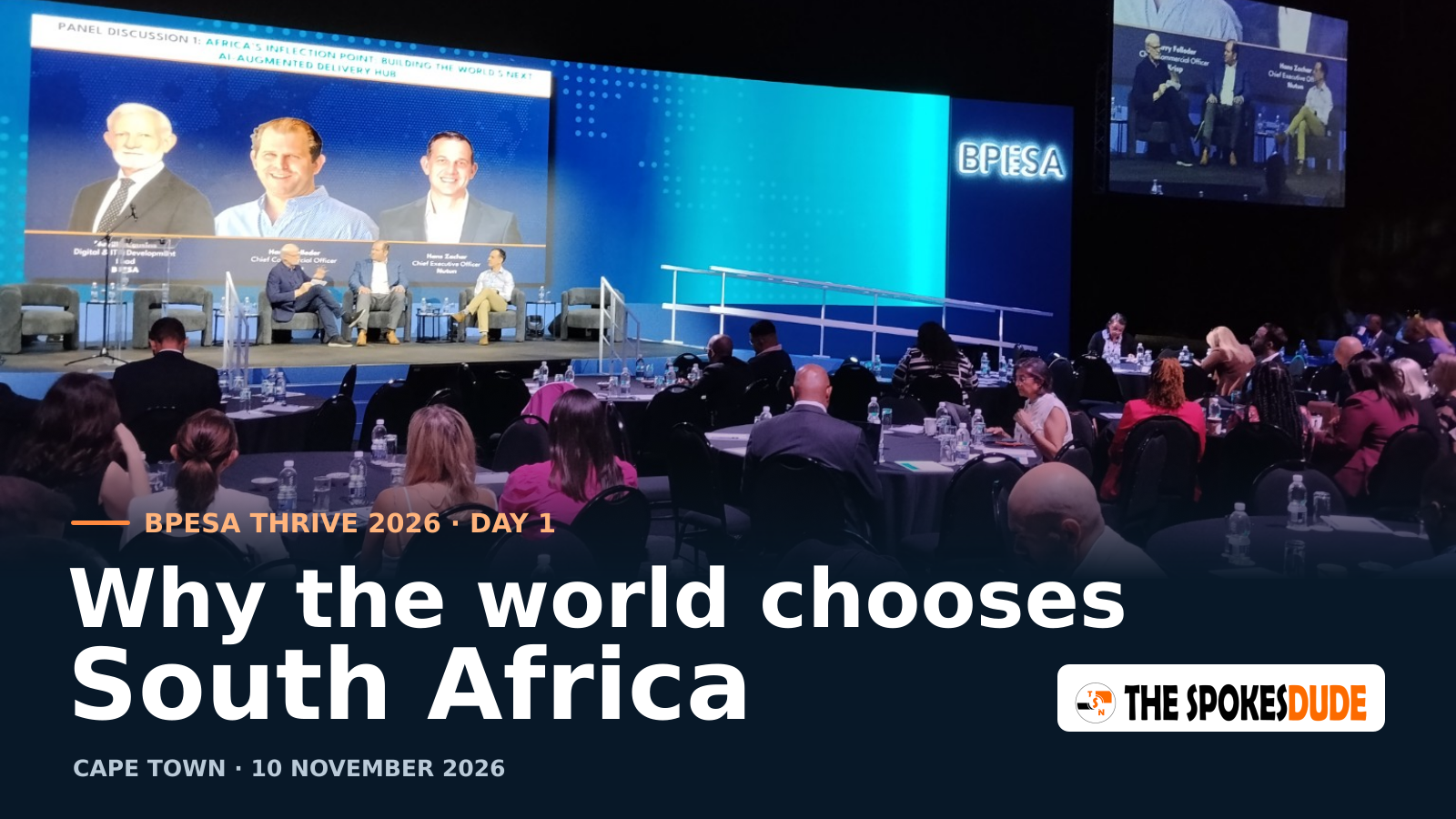
In a session facilitated by BPESA’s Neville Cousins, Krisp’s Harry Folloder showed how real-time, two-way voice translation lets agents serve customers in more than 60 languages. Nutun CEO Hans Zachar spoke about AI handling more routine interactions and the increasingly complex work that human agents will need to take on. We saw a different kind of demonstration when conference host David Rumble held a live conversation with Mfundo, BPESA’s AI co-host. Mfundo summed up the day, suggested LinkedIn talking points and even joked about getting delegates back from their coffee break.
The afternoon panel, led by Dr Jay van Zyl, shared examples from live operations. TransUnion’s Avesh Singh reported R60 million in year-to-date savings, a 67% reduction in legal costs and a 60% reduction in outsourced vendor work in the case he presented. CLEVVA’s Ryan Falkenberg explained why the rules that govern a regulated process need to remain under clear control when AI handles the conversation. Nutun’s Bryce Cressy said AI handled roughly 60–70% of certain customer contact journeys before people stepped in at critical points, and reported a 34% improvement in revenue collection in the example he shared. Those were results from the companies’ own operations. What I took from them was the importance of understanding the process, deciding when a person needs to step in and measuring what changes for the customer.
The AI-augmented delivery panel · The applied AI panel · Mfundo on stage
Higher-value work comes with a higher bar for trust
The Global Capability Centre panel looked at what South Africa could offer international companies building teams for work such as analytics, cybersecurity, engineering and product development. The point that stayed with me was that investors are looking for a business result. A centre designed around a specific problem and the expertise to solve it gives them something concrete to evaluate. It also gives people here a wider range of careers to grow into.
The *THRIVE Through Trust* panel, facilitated by Rita Soni, brought the discussion back to accountability, data governance, human oversight and cyber resilience. One question I carried into my LinkedIn recap was simple. When an AI system handles a customer’s data, can the company explain the steps it took and identify who is accountable for the result?
Sam Rolland of the Economist Intelligence Corporate Network closed the conference programme with *Africa 2027*, looking at how geopolitical and economic uncertainty, AI and Africa’s youthful population could shape investment in services. A young workforce gives the continent an opportunity. What matters is whether people can turn that opportunity into skills, work and careers.
My notes on Global Capability Centres · My Day 1 LinkedIn recap · BPESA programme
An evening for the Alchemy Awards finalists
The day ended with a wonderful evening recognising the Alchemy Awards finalists. Reshni Singh described the gathering as an industry event built and supported by the sector. She linked South Africa’s 2026 Global Sourcing Association Delivery Destination of the Year award to the work of operators, clients and the people delivering those services every day.
Congratulations to all the finalists. It was good to have an evening set aside to celebrate what they’ve already achieved before the winners are announced.
BPESA’s international award announcement
What I’ll watch on Day 2
Day 2 turns to the people behind the sector, from workforce design and leadership to skills and youth employment.
I’ll be listening for how employers turn those conversations into first jobs and careers that people can build on.