BPESA THRIVE 2026 · Day 2 · Session 14: UNFILTERED — Young Voices, Real Conversations
By Lungisa Joctrey · The Spokesdude Network · Cape Town · 11 November 2026
For two days at the BPESA GBS & BPO Conference and Alchemy Awards 2026, we listened to business leaders discuss investment, artificial intelligence, global competitiveness, talent pipelines and the jobs South Africa hopes to create. These are necessary conversations. Yet one session made the meaning of those conversations unmistakably personal.
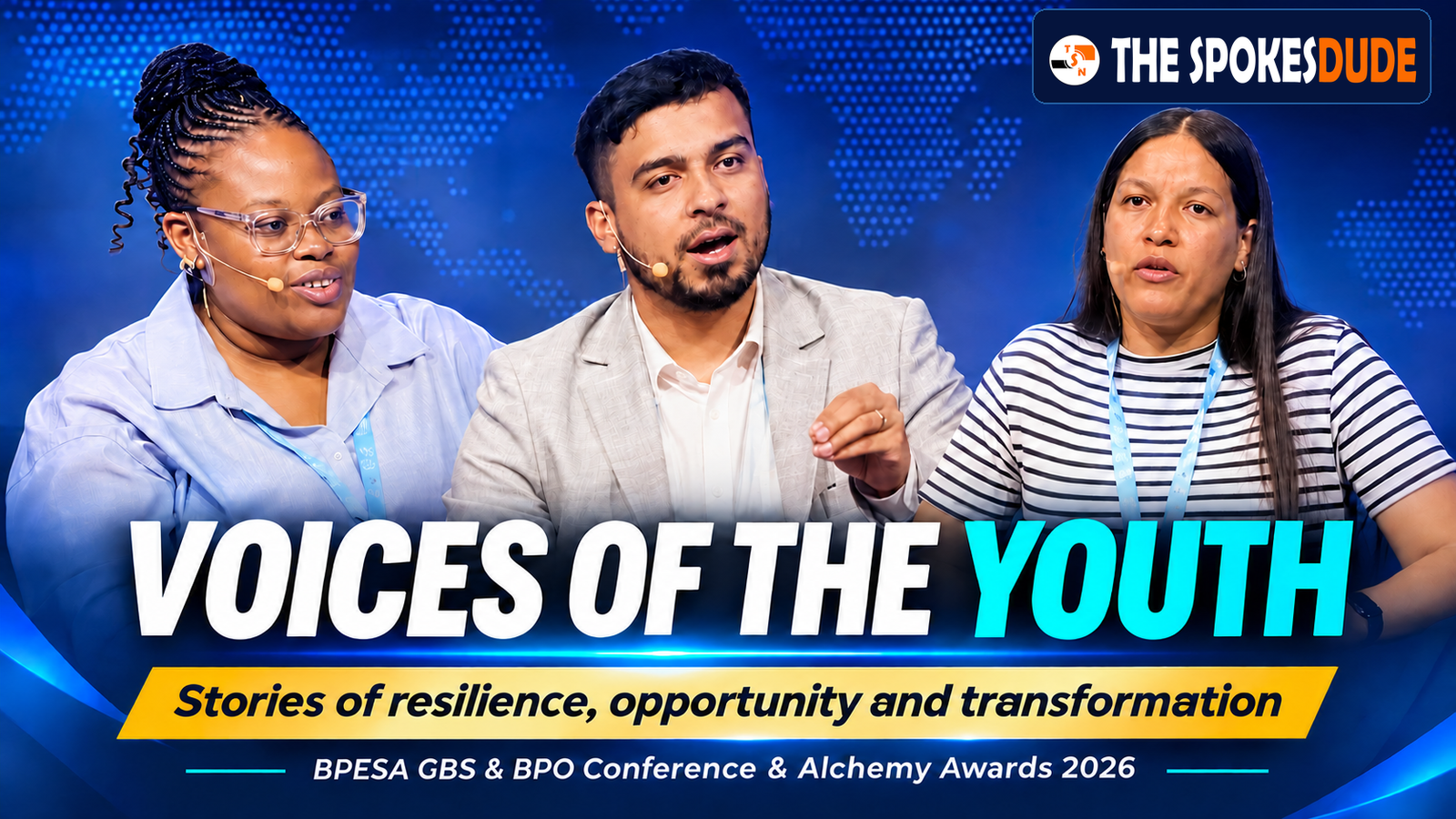
Session 14 was titled 'UNFILTERED: Young Voices, Real Conversations', with the theme 'Breaking the Mould — From Where I Come From to Where I’m Going'. The room heard from Thando Kunene of Afrizan People Intelligence BPO, Sadiqah Adams of Concentrix, and Saalieg Eksteen of Boomerang BPO. Their stories were not simply presentations about career achievement. They were accounts of growing up, finding an opening, learning unfamiliar skills, supporting families and becoming the kind of leaders who can give someone else a chance.
I was moved by their openness. No number on a dashboard could have conveyed the power of this discussion quite as clearly as the young people themselves did.
The stories behind the statistics
A completed skills programme is not the same thing as a secured job. A first placement is not the same thing as a sustainable career. And a headcount cannot show the relief of becoming a household breadwinner, the pride of purchasing a home, or the influence of a mentor who takes time to explain how a business works. The three speakers brought those often-invisible outcomes into focus.
Their backgrounds were different, and so were the doors that opened for them. But their accounts converged around an important idea: someone must offer an opportunity, and then the young person needs the support, confidence and space to grow.
Thando Kunene: from difficult beginnings to creating opportunities for others
Thando spoke about growing up in Katlehong, Ekurhuleni, and the impact that major changes in family circumstances had on her childhood. She described the influence of a grandmother who taught her resilience. She also recalled times when she had to think carefully about food, including whether to save part of what she had so others in the family could eat. Those memories were shared not to invite pity but to explain the determination she carried into adulthood.
She spoke of becoming associated with a family story that was not her own and of consciously refusing to let other people's assumptions determine who she could be. Education offered a way to see possibilities outside the circumstances of her upbringing. Scholarships supported her through school and university, and the chance to travel abroad while studying widened her understanding of the world.
A political science degree was an achievement, but it did not automatically deliver a career. Thando did freelance tutoring, continued applying for jobs and made a decision not to dismiss an opportunity just because the job title was not what she had imagined. A call through Afrizan's youth employment pathway led to interviews and a first role in the GBS industry.
The contact-centre environment came with new acronyms, unfamiliar processes, challenging conversations and the fear that mistakes might stop her from progressing. Thando chose to learn. She approached people in training, quality assurance and other departments, asked questions and looked for ways to contribute. Her career developed through customer service, coaching and specialist work into an assistant contact centre management role.
She told the audience about being entrusted with relocating to Cape Town and helping establish a new contact-centre operation. At first, she encountered an almost empty site. Later, she saw an operation with approximately 100 agents. That transformation was a tangible demonstration of the confidence others had placed in her and the responsibilities she had learned to carry.
What I found especially meaningful was her approach to leadership. Thando wants to spend time on the operations floor, know colleagues as individuals and remember that every employee has circumstances beyond the headset and performance dashboard. She described helping to establish a culture in which people are encouraged, challenged and supported. For Thando, career growth is not a ladder climbed alone; it is an opportunity to lift others.
Sadiqah Adams: a phone call at Spur and a new career path
Sadiqah described a childhood shaped by family separation, the loss of her father when she was young, and the care of a grandmother who provided an essential source of stability. She and her sister lived in a busy home shared with a large extended family, where space and resources were limited. She also spoke with affection and grief about her grandmother, who passed away earlier this year.
Becoming the first person in that household to matriculate carried enormous significance. It gave Sadiqah confidence that she could aim beyond the circumstances around her. Yet she remembered how a low accounting mark once prompted a teacher to congratulate her, leaving her wondering whether other people had already decided what she was capable of achieving. She did not want someone else's expectations to become her ceiling.
After completing her studies, she pursued different opportunities, including administrative internship work connected with the Western Cape Education Department, and worked as a waiter at Spur in Mitchells Plain. Living on tips meant that income could be uncertain, particularly during quiet periods. She continued to apply for opportunities while earning what she could.
Then, on a day she remembered clearly as 19 July, she received a call from Harambee Youth Employment Accelerator while she was serving a customer. The call connected her with training and an employment pathway into the GBS industry. She had applied previously and almost forgotten about it. Suddenly, an opportunity she had not expected was real.
Sadiqah explained that she had not received computer-literacy training at school. Harambee helped close that gap, giving her practical digital and workplace skills before she entered Webhelp, which later became part of Concentrix, as a customer service adviser.
She soon discovered that the industry offered far more than simply taking calls. She sought out quality assurance teams, team leaders and managers to understand their work and learn from them. Curiosity, patience and the willingness to ask for guidance helped her progress through quality assurance and team leadership into operations management.
Her story did not end at a new title. Sadiqah described buying her own home, getting married and preparing to become a parent. She has also spoken to learners at a school in Mitchells Plain about how a contact-centre job can become a long-term career. She wants young people to know about the opportunities that she once did not even realise existed.
Sadiqah's experience shows the difference between telling a young person to find a job and helping them build the skills necessary to enter a particular industry. The initial training gave her access; sustained curiosity and mentoring helped her advance.
Saalieg Eksteen: an interview beside a family food business
Saalieg shared memories of growing up with two younger brothers, sharing what the family had and dreaming that one day they might stand at Old Trafford, the home of Manchester United. He also described growing up around troubling social conditions, including gangsterism, and seeing peers take paths he did not want for himself. He lacked the sort of role model he wished he had known; over time, he decided he wanted to become that example for someone else.
During the COVID-19 period, his family faced major financial hardship when employment was lost. Saalieg and his father worked together in a small food business, selling items such as burritos, burgers and chips. The work helped them survive, but it was not a straightforward route to lasting financial security.
Then Boomerang BPO called. Saalieg was preparing food while taking a telephone interview. He spoke with humour about trying to attend to the customer order and the interview at the same time. He did not yet know that the call would become the start of a five-year journey in the sector.
His first job brought an income when his household needed it and gave him a chance to contribute to the family's stability. The early experience was daunting. Quality assurance, customer satisfaction metrics and other industry terms were new. He worried about failure and about whether he could meet expectations.
He credited the guidance of mentors, colleagues and managers at Boomerang with helping him navigate those unfamiliar responsibilities. He learned that it was better to ask questions than to pretend he had all the answers. Over time, a sense of belonging developed, and he started to trust his own capabilities. He spoke about the importance of showing up in more than the literal sense: being willing to learn, participate and take responsibility.
The benefits extended into his personal life. Saalieg spoke with pride about marriage, a young daughter, the purchase of a family home and a vehicle better suited to the needs of his family. The childhood dream of Old Trafford also became reality when he visited the stadium and stood near the Sir Alex Ferguson Stand.
These achievements are not side notes. They help illustrate what sustained work can mean to a person who once needed an immediate chance to support a household. Income, security, confidence and the freedom to achieve personal goals can all form part of the story of a successful employment pathway.
From being given a chance to giving one
Perhaps the strongest thread joining these stories is that none of the speakers now views success as a purely personal achievement. They understand how much difference a first opportunity, a practical training programme and a supportive manager can make. They want to create similar possibilities for others.
Thando described the responsibility of leading people while understanding the realities of their lives. Sadiqah is speaking to school learners so that they know the sector's career opportunities before they reach adulthood. Saalieg spoke about mentoring, staying available to colleagues and making sure other employees can find their footing.
Their message to industry leaders was not simply to hire more people. It was to recruit more widely, go into communities, provide digital readiness where it is missing, make career paths visible, invest in mentorship and train people for roles they may not yet know exist.
A first job is the beginning, not the full measure of impact
Session 14 followed conversations at the conference about moving from training hours and programme registrations to sustainable employment outcomes. Those conversations matter for funders, government, employers and everyone responsible for reporting on skills programmes. But they also matter for the people behind the data.
When we say a programme has 'placed' a young person, what do we mean? Did they accept the offer? Did they start work? Did they have the digital skills required? Did they remain employed after three, six or twelve months? Did they progress into a more specialised role? Did they begin to build financial security? And what happened to those who did not stay?
We should not treat every personal milestone as an outcome that can be attributed solely to one employer or intervention. Families, individual effort, education, personal networks and economic conditions all contribute. Yet programme data can, if handled responsibly, help us identify which pathways genuinely support progression.
- Access: Which communities hear about these jobs, and who never gets an opportunity to apply?
- Readiness: Which practical skills, including computer literacy and communication, help candidates enter work successfully?
- Placement: How many trainees secure a genuine offer, accept it and actually begin work?
- Retention: Who remains employed after three, six and twelve months, and what explains the differences?
- Progression: Who moves into quality assurance, training, coaching, specialist or management roles, and what support helps them get there?
- Employee experience: Do people feel respected, included, equipped and able to imagine a future with their employer?
This is a point I take seriously through The Spokesdude Network's work in data analysis and programme reporting. A credible dashboard must tell us more than how many people entered a system. It should help decision-makers understand whether their investment is creating sustainable opportunity, identify where candidates are falling through gaps and act before avoidable setbacks become permanent exclusions.
The case for changing how South Africans see GBS work
Many young people still associate contact centres only with answering calls and dealing with frustrated customers. The three speakers described a much broader environment involving training, quality assurance, analytics, workforce planning, operations, customer experience and management. Their paths show why career awareness matters.
Earlier in the conference, business leaders argued that South Africa needs to move from selling workforce capacity towards delivering specialised capabilities. AI will change the nature of some routine work, making continuous learning, problem-solving and leadership development more important. That future cannot be built without strong pathways from entry-level work to more complex responsibilities.
This does not mean every person entering a contact centre will become an executive. It does mean employers can make opportunities for learning and progression more deliberate, transparent and accessible. A first job should not become a dead end because no one explains the next step.
A challenge to the industry: do not wait for young people to find you
One of the panel's strongest challenges was directed at employers and industry leaders. If we want more young people to access GBS opportunities, we should not simply sit in corporate offices and expect everyone to find the application link. We can take the message into schools, townships and communities and make the pathways understandable.
That calls for practical action: visible recruitment requirements, credible skills partnerships, accessible entry routes, meaningful induction, exposure to different business functions and mentors who understand that confidence grows with support. It also asks employers to listen to young workers, rather than assume that a job offer is the end of their responsibility.
The call should be for better jobs and better careers, not only more seats.
What I took home from the room
I have attended many discussions about youth employment in South Africa, and I spend much of my professional life working with evidence that helps programmes explain their results. Yet Session 14 moved me because it showed the human meaning of those numbers.
A record marked 'employed' may be a person who has just become the breadwinner in a household. It may be someone learning how to use a computer for the first time. It may be a woman who goes from waitering to managing people, a young professional trusted to help open an operation, or someone who can finally buy a home and take their family on a journey they once only dreamed of.
And when that person becomes a leader who helps someone else begin, the effect reaches beyond the original employment opportunity.
To Thando Kunene, Sadiqah Adams and Saalieg Eksteen: thank you for sharing your stories. To Harambee, Afrizan, Concentrix, Boomerang and the people who provided opportunities and supported growth: the results you help produce deserve to be understood as careers and lives, not merely counts.
The GBS industry has a strong reason to keep growing. But if we want to claim that growth is transforming South Africa, we must remain committed to what happens after someone gets that first call.
Editorial note and sources
This article is a firsthand editorial account of the BPESA GBS & BPO Conference and Alchemy Awards 2026, Session 14, held in Cape Town on 11 November 2026. It draws on live notes and speech-to-text material from the session. The personal experiences described were shared publicly by the speakers. Statements have been paraphrased and organised for readability; this is not a verbatim transcript.
Further reading: BPESA · Harambee Youth Employment Accelerator · The Spokesdude Network's previous BPESA Day 1 report.