What if the first benefit of artificial intelligence for your business was not replacing employees, but giving them back five hours a week?
For many South African small-business owners, the working day does not end when customers leave. There are invoices to follow up, receipts to capture, enquiries to answer, spreadsheets to update and reports to prepare.
These jobs are necessary, but they consume time that could otherwise be spent serving customers, developing products or growing revenue.
AI automation offers a possible solution. However, buying an AI subscription is not the same as improving a business process.
The better question is: Which repetitive task is costing your business time, and can you automate it safely at a reasonable cost?
South African businesses are using AI, but need practical guidance
According to Xero's 2026 State of South African Small Business research, 52% of surveyed small businesses reported using AI daily or weekly. Yet 56% wanted more support understanding how AI applied to their operations, while 34% felt overwhelmed by AI-related information.
The research surveyed 427 South African small businesses through an online panel in January and February 2026. Its findings describe those respondents and should not be treated as a nationally representative measurement of every SMME.
The challenge is becoming clearer: businesses do not necessarily need more AI tools. They need help identifying useful applications and measuring their value.
Research published by GSMA in June 2026 also highlights barriers involving skills, funding, data quality and responsible AI governance among South African SMEs.
For a small business, the sensible starting point is usually a limited workflow with measurable results.
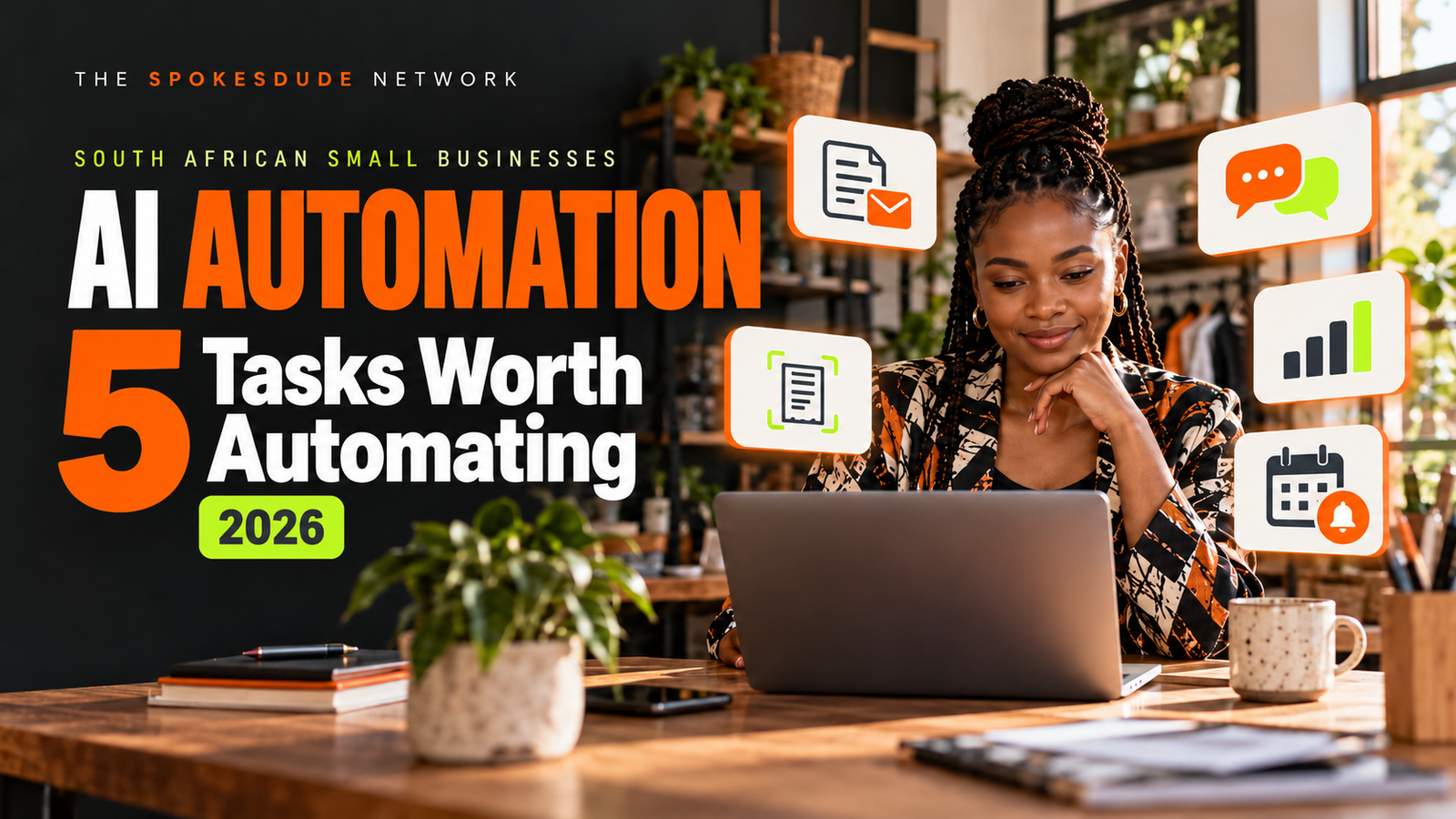
1. Automate invoice follow-up preparation
Late payments can create pressure even when a business is making sales.
Consider a business owner who manually opens a spreadsheet every Monday, checks overdue invoices, copies customer information and prepares payment reminder emails.
A basic automation could identify unpaid invoices past their due dates, organise them by age and prepare reminder messages for review.
AI could help personalise the wording, but the amounts, dates and payment status should come from verified accounting records—not from an AI model guessing the figures.
What to measure: Hours spent preparing follow-ups, overdue invoice totals, the percentage of invoices settled on time and incorrect reminders.
Human checkpoint: A responsible employee approves messages before they are sent, especially where a customer has disputed an invoice.
2. Turn receipts and documents into structured records
Many businesses collect information across paper receipts, emailed invoices, PDFs and photographs.
Someone then has to type the relevant details into Excel or accounting software.
Document-processing tools can extract dates, supplier names, invoice numbers and amounts into a structured table. AI can assist when layouts vary.
However, extracted values must be checked. A misread decimal point or duplicate receipt can produce a financial error.
Start with a small sample of non-sensitive or appropriately protected documents. Compare extracted figures against the originals and calculate the error rate before increasing automation.
What to measure: Minutes per document, extraction accuracy, duplicate rate and manual corrections.
Human checkpoint: Financial records are reviewed and reconciled before posting.
3. Organise customer enquiries before answering them
Customer questions arrive through websites, emails, messaging platforms and social media.
A business may lose opportunities because enquiries sit in different inboxes, receive inconsistent replies or are never followed up.
An automation can collect enquiries into one register, categorise them, identify missing information and assign a follow-up status.
For example, an enquiry requesting a quotation can be separated from an existing customer's support request.
An AI assistant might prepare a suggested response, but it should not invent prices, promise delivery dates or disclose private customer information.
What to measure: First-response time, unresolved enquiries, qualified leads and enquiries converted into paying customers.
Human checkpoint: Employees approve quotations, commercial commitments and sensitive responses.
4. Prepare weekly business performance summaries
A small business may already have its sales figures, expenses and customer records in spreadsheets.
The problem is that the owner must manually consolidate the information each week.
A reporting workflow can combine verified records, calculate indicators and produce a summary showing what changed.
For example, a business could monitor weekly sales, outstanding invoices, operating expenses and repeat purchases.
AI can help turn those validated figures into readable commentary. It should not be allowed to invent missing numbers or provide confident explanations without evidence.
A 15% decline in sales does not automatically mean customers are leaving. It could reflect timing, seasonality, incomplete records or another factor that needs investigation.
What to measure: Reporting preparation time, data completeness, reconciliation differences and decisions taken from the report.
Human checkpoint: A manager verifies the figures and interpretation before circulation.
For businesses that struggle to trust their reports, the starting point may be cleaner data rather than a more sophisticated AI system.
5. Automate routine alerts and administrative reminders
Not every automation requires artificial intelligence.
A stock alert triggered when inventory falls below a threshold may need only a spreadsheet formula or a simple workflow. The same applies to reminders about upcoming appointments, outstanding tasks or missing documents.
AI becomes useful when the process involves interpreting less-structured information, such as categorising incoming requests or summarising a long document.
The distinction matters because simpler tools can sometimes be cheaper, easier to maintain and more predictable.
What to measure: Missed deadlines, stockouts, time spent checking records and the number of false alerts.
Human checkpoint: A designated employee verifies that alerts are based on correct and current information.
How much money could automation save your business?
Before purchasing software, estimate the value of the work involved.
Consider an illustrative business that expects to save five hours of administrative work per week.
- Five hours × four weeks × R100 per hour: R2,000 per month
- Software subscription: −R300 per month
- Additional quality checks: two hours × R100: −R200 per month
- Potential net capacity value: R1,500 per month
This is an illustrative calculation, not a real customer result or guaranteed financial saving.
The R100 hourly value represents an assumption about the business's cost or opportunity value of staff time. The R1,500 only becomes a financial benefit if that capacity can be converted into avoided costs, productive work or additional revenue.
A useful measurement is:
Net monthly automation value = Value of productive time saved − software costs − additional checking and maintenance costs.
If an automation saves two hours but creates three hours of error correction, it has not improved productivity.
What about customer privacy and POPIA?
South African businesses must be careful when introducing customer, employee or supplier information into AI tools.
The Protection of Personal Information Act (POPIA) creates obligations relating to lawful processing and appropriate safeguards for personal information. It does not mean every processing activity requires consent, but the business must have an appropriate legal basis and meet the applicable requirements.
Before using an AI service with personal information, investigate what data it receives, how long it keeps the information, which parties may access it and whether information is transferred internationally.
Do not casually paste identity numbers, banking records, payroll information, confidential agreements or customer databases into an unapproved AI service.
For higher-risk decisions, particularly those substantially affecting individuals, a business should obtain appropriate legal and compliance guidance. POPIA section 71 contains specific restrictions and exceptions concerning certain solely automated decisions.
The safest first experiment is often to use fictional, anonymised or appropriately de-identified test records.
Useful reference: South Africa's Information Regulator.
A practical 30-day plan to start
Week 1 — Understand the problem. Choose one repetitive task. Record how often it occurs, how long it takes, its error rate and who is responsible.
Week 2 — Design the workflow. Decide whether the task requires AI, straightforward rules or simply a better spreadsheet. Define the data inputs, expected outputs and human approval points.
Week 3 — Test on a limited sample. Run the new process alongside the existing method. Compare accuracy, time and cost. Record failures rather than hiding them.
Week 4 — Make a decision. Calculate whether the benefits exceed subscription fees, maintenance and review costs. Expand only if the process is dependable and measurable.
A successful first automation should be small enough to understand, easy to stop if something goes wrong and useful enough to justify its cost.
Frequently asked questions
Can a small business automate work without expensive AI software?
Yes. Some processes can be improved using spreadsheet formulas, templates, scheduled reminders or existing accounting-system features. AI is useful when it adds value beyond these simpler methods.
Should AI automatically respond to all customers?
Not necessarily. Routine enquiries may be suitable for assisted drafting or carefully controlled responses. Complaints, quotations, unusual requests and sensitive information often need human oversight.
What is the best first AI automation for a small business?
Start with a repetitive, measurable, relatively low-risk task that already has reliable input data. The best choice depends on the business's actual bottleneck, not the popularity of a particular AI product.
Conclusion: Automate the problem, not the hype
Artificial intelligence can help South African businesses reduce repetitive work, improve reporting and serve customers more efficiently.
But automation only creates value when the business understands the process being automated.
Start with one problem. Measure the current cost. Build a controlled solution. Test its accuracy. Then decide whether the investment deserves to grow.
For small businesses, the strongest AI strategy may not be the most advanced technology.
It may simply be the one that gives people more time to do meaningful work.
Need help identifying a workflow worth automating? The Spokesdude Network works with businesses on data cleaning, reporting and practical automation. Get in touch to discuss the problem before investing in new software.
Research and references
- Xero — State of South African Small Business 2026, media release and survey methodology
- GSMA — Scaling AI for SMEs: South Africa's AI Data Governance Environment
- NIST — Generative AI Risk Management Profile
- South African Information Regulator
Editorial note: Calculations and workflows are illustrative examples developed for this article. They are not verified results from TSN client engagements.