
Executive summary
AI is making data analysis faster, more accessible and easier to automate for small businesses. From cleaning recurring datasets to generating reports, exploring trends and building simple internal tools, AI can reduce manual effort and help teams reach insights sooner. But the real value still depends on trustworthy data, clear business rules and human judgement.
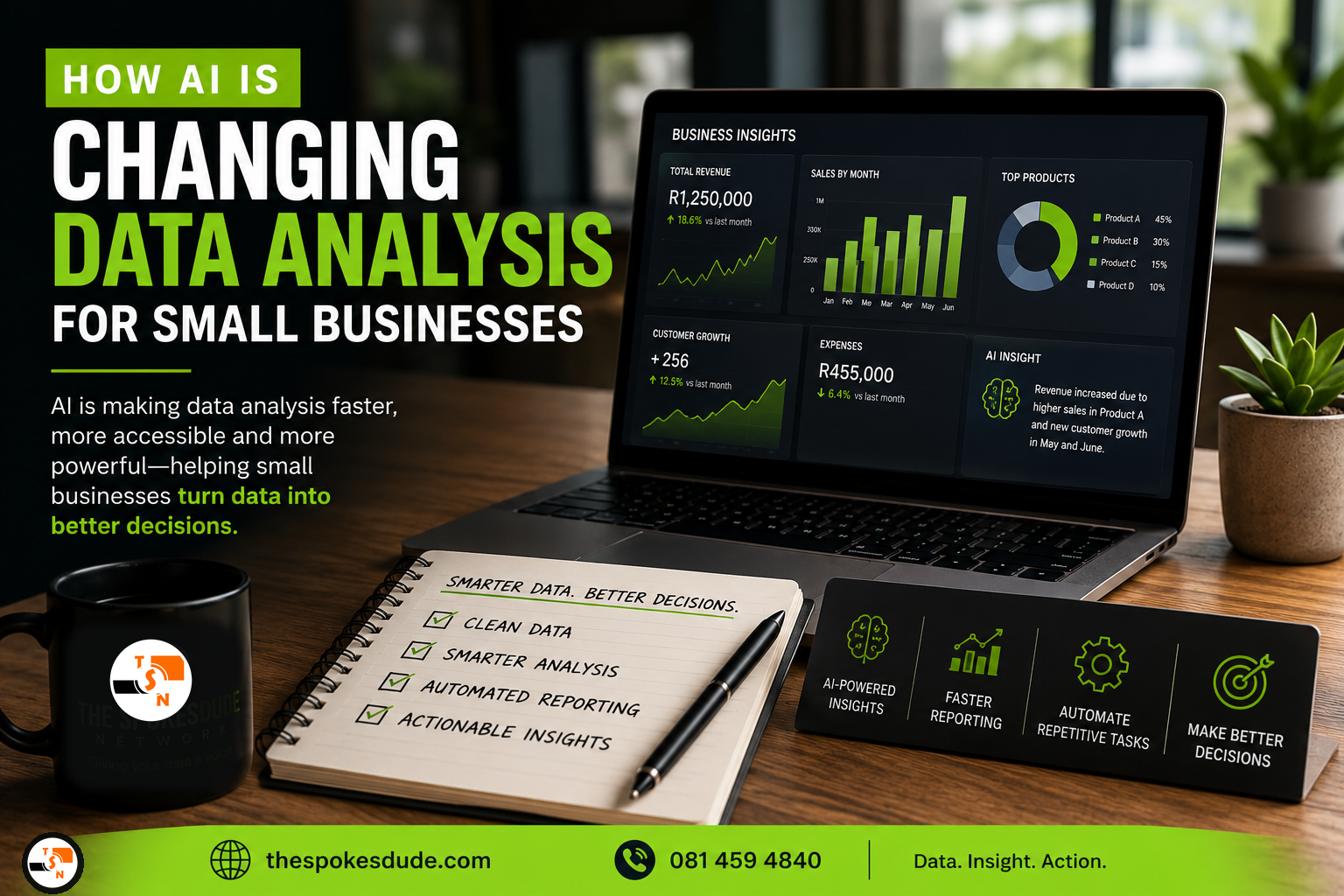
Artificial intelligence is changing the way businesses work with data. For years, advanced data analysis often required specialist teams, expensive software and significant technical expertise. Small businesses could collect information but turning that information into reliable insight was often slower, more manual and more dependent on people who knew how to build formulas, models, queries and reports. That is beginning to change. AI tools can now help people explore datasets, generate code, identify patterns, summarize results, explain trends and automate parts of the reporting process far more quickly than before. Tasks that once required hours of technical work can sometimes be completed in minutes. For small businesses, this creates an important opportunity. It does not mean that AI suddenly makes every company a data science organization. It does mean that businesses with limited resources can access analytical capabilities that were previously much harder to obtain. The real value, however, is not simply that AI can work faster. The value is that AI can help reduce the distance between having data and understanding what the data is saying.
Small Businesses Already Have More Data Than They Think
Many small businesses assume that data analytics is something for large companies with sophisticated systems. In reality, most businesses already produce data every day. Sales records, invoices, customer details, quotations, website activity, stock movement, service requests, expenses, project records and employee activity all create information that can potentially support better decisions. The problem is usually not a complete lack of data. The problem is that the information is scattered across spreadsheets, accounting systems, customer platforms, emails and other tools. It may be inconsistent, incomplete or difficult to combine. This means the business can have plenty of information while still struggling to answer basic questions. - Which products are performing best? - Which customers generate the most value? - Where are costs increasing? - Which services are becoming less profitable? - What changed this month? - Where should management focus next? AI can help make some of these questions easier to investigate, but only if the underlying data is usable.
AI Makes Analysis More Accessible
One of the biggest changes AI brings to data analysis is accessibility. Traditionally, someone who wanted to analyze a dataset might need to know Excel formulas, SQL, Python, statistics or business intelligence tools. Those skills remain extremely valuable, but AI can now help bridge some of the technical gaps. A user can describe what they want in plain language and ask an AI system to help calculate it, explain it or build the logic required to analyze it. For example, a business owner may want to understand which customer segment grew the fastest over the past six months. An AI assistant may help generate the SQL query, Python code or spreadsheet formula required to perform that analysis. It can then help explain the result in ordinary business language. This does not remove the need for technical understanding. It changes the way people interact with technical tools. Instead of having to remember every command or formula from scratch, the user can focus more on the business question and use AI to assist with the implementation.
AI Can Speed Up Repetitive Data Preparation
A large amount of data work happens before analysis begins. Columns need to be renamed. Dates need to be standardized. Duplicate records need to be identified. Categories need to be cleaned. Missing values need to be investigated. Files need to be combined. For small businesses, this work can consume a significant amount of time because the same tasks are often repeated every week or every month. AI can help accelerate this process. It can assist with writing transformation logic, suggest ways to standardize inconsistent values and help create scripts or workflows that reduce manual cleaning. For example, if a business receives several CSV files every month, AI can help develop a repeatable process that combines those files, checks their structure and prepares them for reporting. The important word is repeatable. The biggest gain is not that AI cleans the file once. The gain comes when the business turns a recurring manual task into a documented process that can be repeated reliably.
AI Can Help People Ask Better Questions
Good data analysis begins with good questions. This is one area where AI can be surprisingly useful. A small business owner may know that sales declined but may not immediately know how to investigate the reason. AI can help suggest useful follow-up questions. - Did the decline affect every product or only certain categories? - Was the change concentrated in one region? - Did customer numbers decrease, or did customers simply spend less? - Did pricing change? - Did the business lose one large customer? - Is the decline unusual, or does it happen every year during the same period? These questions do not require AI to make the final decision. They help management explore the problem more systematically. In this sense, AI can act as an analytical assistant. It can help the business move beyond simply observing what happened and begin investigating why it happened.
Reporting Can Become Faster
Many small businesses still produce reports manually. Data is exported from one system, copied into another spreadsheet, cleaned, summarized and then turned into charts. Next month, the same process happens again. AI-assisted development can help businesses reduce some of this repeated work. Instead of manually rebuilding a report, AI can help create Power Query transformations, SQL scripts, Python workflows or small internal applications that automate recurring tasks. It can also assist in building measures, validating logic and explaining errors when something breaks. This is particularly important for small businesses because they may not have a full-time data engineer or software developer available. AI can help a small technical team, or even one capable analyst, do more. The result can be faster reporting without immediately requiring a much larger workforce.
AI Can Help Explain the Numbers
A chart can show that revenue declined. It does not automatically explain why. This is where many businesses struggle. They produce reports but still need someone to interpret what the information means. AI can help with this stage by summarizing trends, highlighting changes and generating first-draft explanations based on the data provided. A monthly business report could, for example, identify that overall revenue declined while one product category grew strongly. It may also notice that customer numbers remained stable but average order value fell. That can help management focus the discussion. The key is that AI should support interpretation, not replace judgement. A system can highlight a pattern. It may not understand a supplier dispute, a local competitor, a public holiday, a customer relationship or an operational issue that explains the pattern. Human context still matters.
AI Is Making Small Custom Tools More Realistic
Another major change is that AI is reducing the cost and time required to build simple internal software. A business may not need a large enterprise platform. It may simply need a small tool that uploads a spreadsheet, checks the data, calculates key measures and produces a report. In the past, even a relatively simple application could require significant development time. AI-assisted coding tools are changing that. Developers can now use AI to accelerate the creation of dashboards, internal portals, automation tools and proof-of-concept applications. For small businesses, this means the gap between “we have this problem every month” and “we have a tool that solves it” can become much smaller. This does not mean every AI-generated application should immediately be trusted with critical business processes. Testing, security, data protection and quality control still matter. But it does mean that experimentation has become faster and more affordable.
AI Does Not Fix Poor Data
This is one of the most important limitations to understand. AI can analyze bad data just as confidently as good data. If the source contains duplicated customers, missing transactions or incorrect categories, the analysis may be misleading. If one department defines an active customer differently from another, AI cannot decide which definition the Organisation should use unless that rule is provided. If the data is incomplete, the output may also be incomplete. This is why businesses should resist the idea that AI makes data quality less important. It actually makes data quality more important. The faster analysis becomes, the faster poor data can create poor conclusions. AI is powerful, but it still depends on the information it receives.
Human Review Still Matters
AI systems can make mistakes. They can misunderstand a question. They can write code that looks correct but produces the wrong result. They can generate explanations that sound convincing even when the underlying logic is weak. This is why human review remains essential. Businesses should be able to validate important numbers. It should understand the rules behind its KPIs. It should know where its data comes from. And it should investigate unusual results rather than accepting every AI-generated explanation automatically. The goal should not be to remove humans from data analysis. The goal should be to use AI to remove unnecessary effort so that people can spend more time on judgement, interpretation and action. AI Can Lower the Cost of Experimentation Small businesses often avoid analytics projects because they fear the cost. They may assume they need to buy expensive software, hire several specialists or begin a major digital transformation programme. AI creates another option. A business can start smaller. It can test whether a recurring reporting process can be automated. It can explore whether a dashboard would improve management meetings. It can build a simple prototype before investing in a large platform. It can experiment with different ways of analyzing customer, operational or financial information. This lower cost of experimentation is important. It allows small businesses to learn what actually works before making larger investments.
The Most Valuable Use of AI May Be Behind the Scenes
When people think about AI in business, they often imagine chatbots. Chatbots can be useful. But some of the most valuable AI applications may be invisible to the customer. AI can help generate data-cleaning scripts. It can help developers troubleshoot integration problems. It can assist analysts in writing formulas and measures. It can summarize large reporting outputs. It can support documentation. It can help detect unusual patterns. It can accelerate the development of internal tools. These applications may not look dramatic. But they can improve productivity significantly. For a small business, saving several hours every reporting cycle can have a real financial impact.
Small Businesses Need to Be Careful With Sensitive Data
The convenience of AI creates another important responsibility. Businesses should not upload confidential or personal information into AI systems without understanding how the platform handles that data. Customer records, employee information, financial details and other sensitive information require proper governance. Before using an AI tool, the organization should understand what information is being shared, whether the platform retains it and whether its use is appropriate under the organization’s legal and privacy obligations. The faster AI adoption becomes, the more important these controls become. Convenience should not come at the cost of trust. AI Should Support a Process, Not Become the Process A business should be able to explain how its reporting works even when AI is involved. Where does the information come from? What cleaning rules are applied? How are KPIs calculated? Who reviews the results? What happens when an error is found? If the answer to every question is simply, “The AI does it,” the organization may be creating a new dependency without creating a reliable system. AI should support a documented process. The process should not disappear inside the AI. This distinction becomes increasingly important as organizations rely on automation for more decisions. The Best Results Come From Combining AI With Business Knowledge AI is good at processing information, generating possibilities and assisting with technical work. The business understands its customers, products, strategy, constraints and environment. The strongest results come when these capabilities work together. A business owner may know that a revenue decline was caused by a delayed shipment. An AI system may identify which products and customers were most affected. An analyst may then quantify the impact and build a monitoring process. Management can use that information to decide what should happen next. Each part contributes something different. AI becomes most useful when it strengthens human understanding rather than pretending to replace it.
What This Means for Small Businesses
The biggest change is not that every small business suddenly needs an AI department. It is that sophisticated data capabilities are becoming easier to access. A business can automate repetitive reporting. It can analyze information more quickly. It can build prototypes faster. It can use natural language to interact with technical tools. It can create internal applications that would previously have required much more development effort. But the fundamentals remain the same. The business still needs good data. It still needs clear definitions. It still needs reliable processes. It still needs people who understand what the information means. And it still needs leaders who can decide what action should follow.
AI Changes the Tools, Not the Purpose
At The Spokesdude Network, the purpose of data analysis remains straightforward. Clean the information. Structure it properly. Understand what it is saying. Turn that understanding into action. AI can make parts of this process dramatically faster.
It can help automate tasks, accelerate development and make analysis more accessible. But the objective is not AI for the sake of AI. The objective is to make better decisions. For small businesses, that distinction matters. The most valuable AI strategy may not begin with asking, "How can we use AI?" It may begin with asking: “Which recurring business problem could we solve better if our data and technology worked smarter?” That is where practical AI begins.
Could AI Make Your Reporting and Data Work More Efficient?
The Spokesdude Network helps organizations clean, structure, analyze and report their data while exploring practical ways to use automation and AI-supported tools. We focus on business problems first, then use the appropriate combination of data analysis, Power BI, automation and software tools to create reliable solutions. If your organization spends too much time preparing reports, cleaning recurring datasets or struggling to turn information into clear decisions, there may be opportunities to simplify the process. Visit thespokesdude.com or contact 081 459 4840 to discuss your data, reporting and automation needs.
The Spokesdude Network — Giving your data a voice.