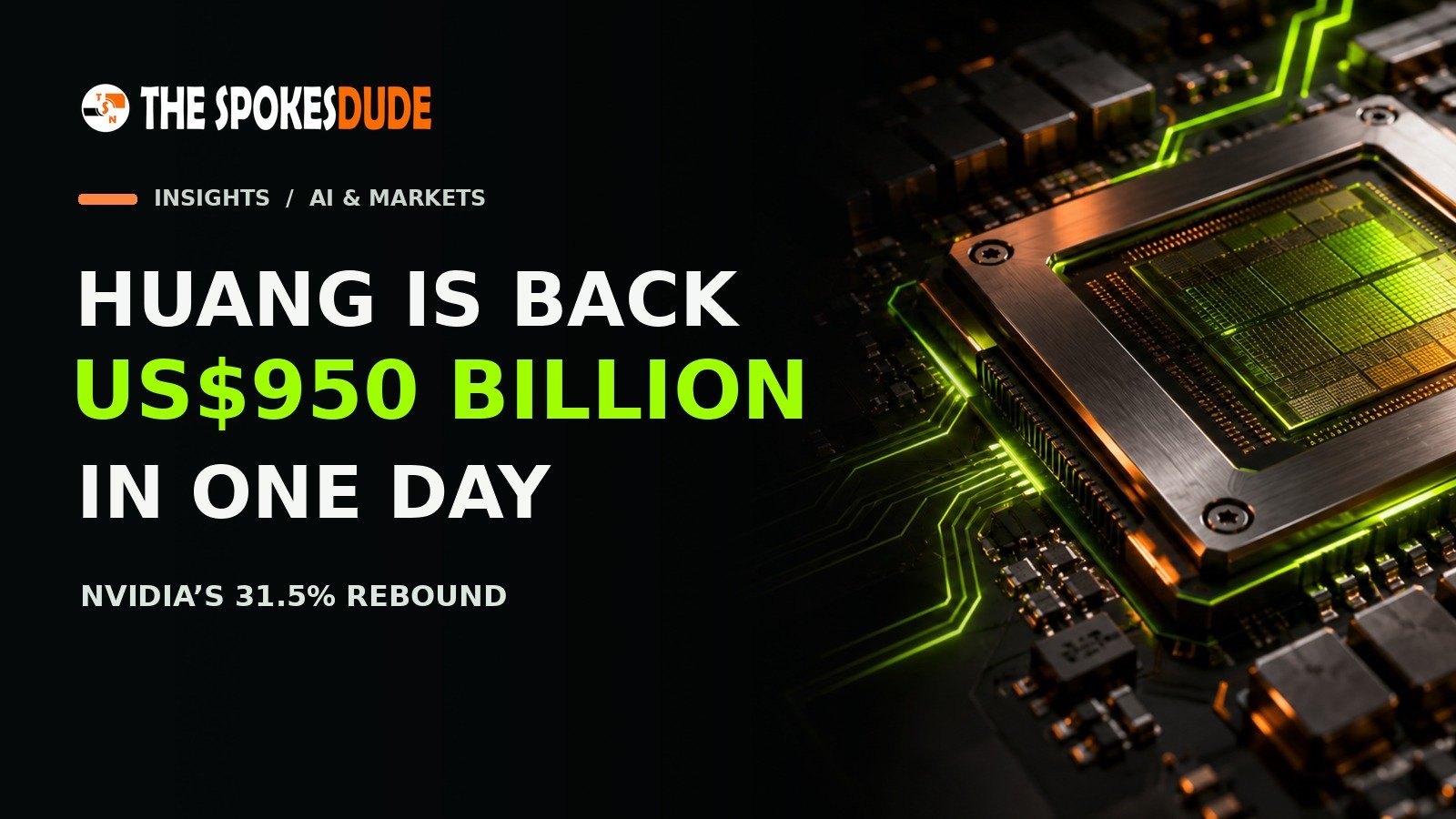
On Friday, 20 November, NVIDIA shares closed at US$125.53. On Monday, they closed at US$165.05. Between those sessions, the board brought back Jensen Huang. The share price rose 31.5%, adding roughly US$950 billion to NVIDIA’s market value at the close. Market reporting put it at the largest one-day gain for a U.S.-listed company. By Tuesday’s close, the stock had given back some of the gain. The appointment still stood. Investors had simply changed what they were willing to pay again. Historical closing prices · Market-value comparison
When we published our first piece on NVIDIA after Jensen Huang, we asked what his departure meant for AI, chips and trust. His return answers the immediate question of who leads the company. It leaves a more useful question for the rest of us: how much of an AI plan depends on decisions made somewhere else, and what can a business do about that before a supplier changes course?
The board decided on Sunday. The market reacted on Monday.
The dates are worth getting right. NVIDIA’s earlier filing records the board’s acceptance of Huang’s resignation on 11 November. The departure was announced on 12 November, and Chief Financial Officer Colette Kress served as interim CEO. The reinstatement filing dates the board’s decision to Sunday, 22 November, effective immediately. The company announced the decision publicly on Monday, 23 November, the next trading day. Huang returned as president, CEO and a board director.
In its public statement, NVIDIA said the vote was unanimous and followed discussions with Huang. The company also said the board received input from senior levels of the U.S. government and, based on that input, expressed confidence that his return posed no national security risk. That is the board’s stated assessment and should be attributed to it. The statement tells readers who made the decision and what the board said it considered. It does not provide a public accounting of every underlying question, or turn separate allegations into established facts.
The distinction also gives us a better way to read corporate news. A filing is the best starting point for the date, appointment and scope of the decision. A company statement explains how the company presents it. A trading record tells us what happened to the price. Each answers a different question. None, by itself, tells us how much investors valued any one part of the announcement or what customers will experience in the next quarter. Read together, they give a more useful account than a headline that compresses everything into one cause and one consequence.
Where the US$950 billion comes from
Here are the three U.S. closing prices around the announcement. They are closing prices, rather than intraday highs or after-hours quotes. Daily trading history
- Friday, 20 November: US$125.53 at the close, the baseline for this comparison.
- Monday, 23 November: US$165.05 at the close, up 31.48%.
- Tuesday, 24 November: US$155.38 at the close, down 5.86% from Monday.
The Monday increase was US$39.52 per share. Divide that by Friday’s close of US$125.53 and the result is 31.48%, or 31.5% rounded. Market capitalisation is the share price multiplied by the number of shares outstanding. Using approximately 24.1 billion shares, the figure NVIDIA disclosed on the cover of its August quarterly filing, the change comes to about US$952 billion. This is a scale check using a dated share count, not a claim that precisely that number of shares was outstanding on 23 November. It explains why different market-data sources can give slightly different figures while agreeing on the magnitude.
That calculation puts NVIDIA’s market value at roughly US$3 trillion on Friday and roughly US$4 trillion on Monday. It also makes the comparison easier to interpret. The record is a dollar increase in one company’s market value over a single session, not a record percentage return for every U.S. stock. Opening Bell Daily’s comparison put the gain at US$952 billion and ranked it above the previous record. “Nearly US$1 trillion” is fair shorthand. Saying NVIDIA gained a full trillion dollars at the close would overstate the number.
It is also worth spelling out what the money represents. The market applies the latest share price to all outstanding shares, even though only some of them traded that day. A higher market capitalisation does not mean buyers collectively handed that amount to the company on Monday. It does not show up as an increase in revenue and does not pay for a new factory or more compute by itself. Market value can affect how a company is perceived and what commercial options it has, but it is a different measure from cash, sales or operating results.
Why the timing matters, and where the explanation stops
It is reasonable to treat Huang’s return as a major part of the story. Restoring a longstanding leader can change what traders expect about strategic continuity, decision-making and relationships with customers or partners. If some investors had reduced their exposure because the leadership change made the next year harder to judge, the reinstatement gave them something concrete to reconsider. That is an interpretation of the reaction, not a measurement of the dollar value attributable to one executive.
The wider market matters too. Associated Press’s session recap reported a 6.5% gain in the Nasdaq Composite on Monday and noted that U.S. stock futures already pointed towards a rebound before NVIDIA’s announcement. NVIDIA’s 31.5% gain was much larger than the index move. The comparison shows the stock stood out in a strong session, but subtracting 6.5 from 31.5 does not isolate the effect of Huang’s return. The index and the company are exposed to different risks, and a broad rebound can amplify how traders respond to company news.
Tuesday provides a check on the temptation to tell a tidy story. At US$155.38, NVIDIA still closed about 23.8% above the previous Friday’s price. It had also fallen nearly 6% from Monday. The first figure shows that much of the rebound remained after a second session. The second shows how quickly the number attached to the same corporate decision could move. Neither closing price gives a final verdict on the company’s leadership, the board’s judgment or the economics of the wider AI industry.
For readers using market news to make business decisions, the useful habit is to ask which decision the evidence can support. It might justify flagging NVIDIA for closer monitoring if the company is a critical part of your supply chain. It does not tell you to change a signed service agreement, accelerate a server order or increase a project’s budget. Those decisions require evidence closer to your own operations.
Put the underlying business on a different page
NVIDIA’s 17 November earnings release gives another lens. The company reported US$115.8 billion in revenue for its third fiscal quarter, up 103% from a year earlier. It reported US$107.6 billion in Data Center revenue, up 110% year on year, and said the Vera Rubin NVL72 had shipped. Data Center made up roughly 93% of reported quarterly revenue. The scale helps explain why leadership changes at NVIDIA draw attention well beyond the company itself.
The reporting period ended on 25 October, before the November departure and return. Those historical sales results therefore cannot show whether either leadership decision helped or hurt the quarter. Equally, a statement that a product has shipped establishes a delivery milestone for NVIDIA. It does not confirm how many units a particular cloud provider will offer in your chosen region, what a reseller can deliver by March, or the price your business will pay.
For customers, a better evidence chain starts with the commitment that affects them. If a project requires a particular accelerator, ask the supplier to confirm the region, available configuration, lead time and commercial terms in writing. If the project uses an AI service rather than hardware directly, ask about the service’s capacity, version changes and response to outages. Read the corporate roadmap for context, then buy against what the provider is prepared to commit to.
This is also where a governance question becomes practical. A supplier’s continuity plan can be assessed without guessing what happened in its boardroom. Who is authorised to approve changes? Which commitments survive a change of account manager, executive or subcontractor? How much notice does the customer get if a service is withdrawn? Can the supplier show how existing customers would transition? These questions are more revealing than trying to infer service quality from a stock chart.
Where South African businesses are actually exposed
A small business may never place an order with NVIDIA and still depend on infrastructure built around its products. A firm could subscribe to a hosted model through an application vendor, rely on that vendor to process customer documents, and be billed in dollars or through a rand-denominated reseller contract. The immediate dependency is the vendor and its service terms. The underlying chips matter if they affect available capacity, lead times or cost, but the chipmaker’s share price does not determine those outcomes on its own.
Start by identifying the outcome the business buys. For a document-processing tool, that might be extracting figures into an accounting review queue. For a customer-support tool, it could be drafting a response with a human approving it. The contract, workflow and failure mode for those jobs deserve more attention than the brand of the processor. A business cannot manage “AI risk” in the abstract. It can manage a delayed document, a failed extract, an unexpected bill or a queue that staff cannot clear.
Currency is a separate dependency. If you earn in rand but buy a cloud service in U.S. dollars, estimate what a weaker rand would do to the monthly bill before blaming a hardware supplier for an increase. Where a reseller quotes in rand, check how often it can reprice and which charges fall outside the quoted fee. Compare like with like: include fixed fees, usage charges, any implementation work and the staff time needed to review and correct outputs. The cost to watch is the cost of a completed task that meets your standard.
Finally, find out which parts of the supplier chain matter for data handling. For some teams, a fallback service that can process a booking enquiry is straightforward. Moving payroll records or learner data is a different proposition. A technical alternative has little practical value if it cannot be used under the customer’s data-handling rules, or if the fallback sends sensitive information somewhere the business has not approved. Identify and test the fallback with fictional or otherwise approved data before relying on it in production.
A worked example: a quote that looked cheaper
Imagine a fictional South African team using AI to extract fields from supplier invoices. It handles 2,000 documents a month and has agreed that no invoice will be posted without a human checking it. Provider A charges the equivalent of R3 per document. On a representative trial, one in ten documents needs manual correction, and the team estimates R12 of staff time per correction. Its monthly variable cost is R6,000 for processing plus R2,400 for corrections, or R8,400. The example excludes fixed platform fees and taxes so the two cost drivers are clear.
Provider B offers processing at R2.60 per document. If one in five documents needs a correction at the same R12 staff cost, the alternative comes to R5,200 plus R4,800, or R10,000. The cheaper headline rate produces the more expensive workflow under those assumptions. But B might still be a viable temporary fallback if delay costs more than the difference and both providers satisfy the same security and review requirements.
Now test what changes when the conditions change. If B’s correction rate falls to 12% after a pilot, the illustrative monthly variable cost falls to R8,080. If A is dollar-priced and its rand processing cost rises 15% with other assumptions unchanged, the same workflow costs R9,300. Those two calculations tell the buyer where to ask better questions: does the accuracy improvement hold on difficult invoices, and could the supplier quote terms that reduce currency exposure? The exercise is not a prediction about either provider or about NVIDIA. It is a simple way to build a decision that will survive a change in prices or assumptions.
There is one more line worth adding to the comparison: recovery time. If Provider A goes down, how long would it take to re-route a day’s invoices without creating duplicate records? If Tuesday’s queue is replayed on Wednesday, can the team distinguish a document already processed from one that failed halfway? Two quotes with identical processing fees can carry very different costs if one platform makes it hard to recover your own work. Design for that operational detail while the project is still small.
Five things to do before renewal or rollout
- Name the jobs that cannot stop. List the AI-enabled workflows that support paying customers, staff or reporting deadlines. For each, record the impact of one hour, one day and one week without service. Assign an owner. Where interruptions are tolerable, a manual fallback may be enough.
- Map the dependencies you can verify. Record the application vendor, hosting region, model or processing service where known, and the place your data is stored. Mark unknowns as unknowns. Ask the supplier to clarify the ones that could affect your operations. Do not assume two visible brands use genuinely different infrastructure.
- Read the clauses that change your options. Check notice periods, usage limits, pricing currency, support commitments and the terms under which you can export your data or change providers. Obtain a documented route to recover your own records. Set a reminder for the renewal decision rather than waiting for the first higher invoice.
- Test the part that is hardest to move. Take a small, representative sample, preferably with fictional or approved records. Run both routes against the same acceptance criteria. Measure accuracy, speed, review effort, failed records and what happens when the service is interrupted. Record the result before you need to make a decision under pressure.
- Set a trigger for revisiting the plan. Choose the maximum monthly cost, downtime or delivery delay the business can tolerate. Tie each limit to a specific action, such as a price discussion, activation of a manual queue, or a controlled switch after a successful test. Make clear who can make that call.
The aim is not necessarily to pay for two everything. You can get useful continuity from a clean data export, a documented process and a small contingency test. A second paid supplier may be justified for work that cannot wait, but running two vendor contracts for a workflow no one depends on can add cost without buying much resilience. The right decision depends on the consequence of failure, how quickly the team could recover and how much control it has over the work.
What would count as evidence from here?
Watch different measures for different questions. For the market, a series of closing prices tells you more about how much of Monday’s move held than an intraday screenshot. For governance, future filings and statements can establish changes in board oversight, succession arrangements or how a specific matter is being handled. For the operating business, results covering periods after the reinstatement, along with guidance and shipment updates, can help separate delivery from expectations. For an AI buyer, the most useful measure may be closer to home: actual service availability, real turnaround time and cost per accepted output.
Know what would make you change your mind. A supplier’s roadmap may be impressive, but if a pilot underperforms on your own documents, it is reasonable to narrow the scope. Conversely, if the supplier meets its commitments and your project has a tested exit plan, a volatile week on the stock market is no reason by itself to postpone useful work. The discipline works in both directions: do not let a big rally make you complacent, and do not let a big sell-off cause you to abandon a well-tested decision.
Huang’s return was a real board decision, announced on 23 November. The 31.5% rebound was a real close-to-close move. The US$950 billion was an estimate of how much market value was added, and it was reported as a U.S. record. Those facts can all be true without resolving what AI will cost your business next year, what its providers will deliver or how well its workflows will hold up when something breaks. That last set of questions is yours to answer. Start with one workflow, one supplier commitment you can verify, and one fallback you have actually tried.