
Executive summary
Before investing in new software, take a closer look at the data and processes you already have. New technology cannot automatically fix duplicated records, inconsistent definitions, poor data capture or unclear reporting rules. A stronger data foundation makes every future technology investment more valuable.
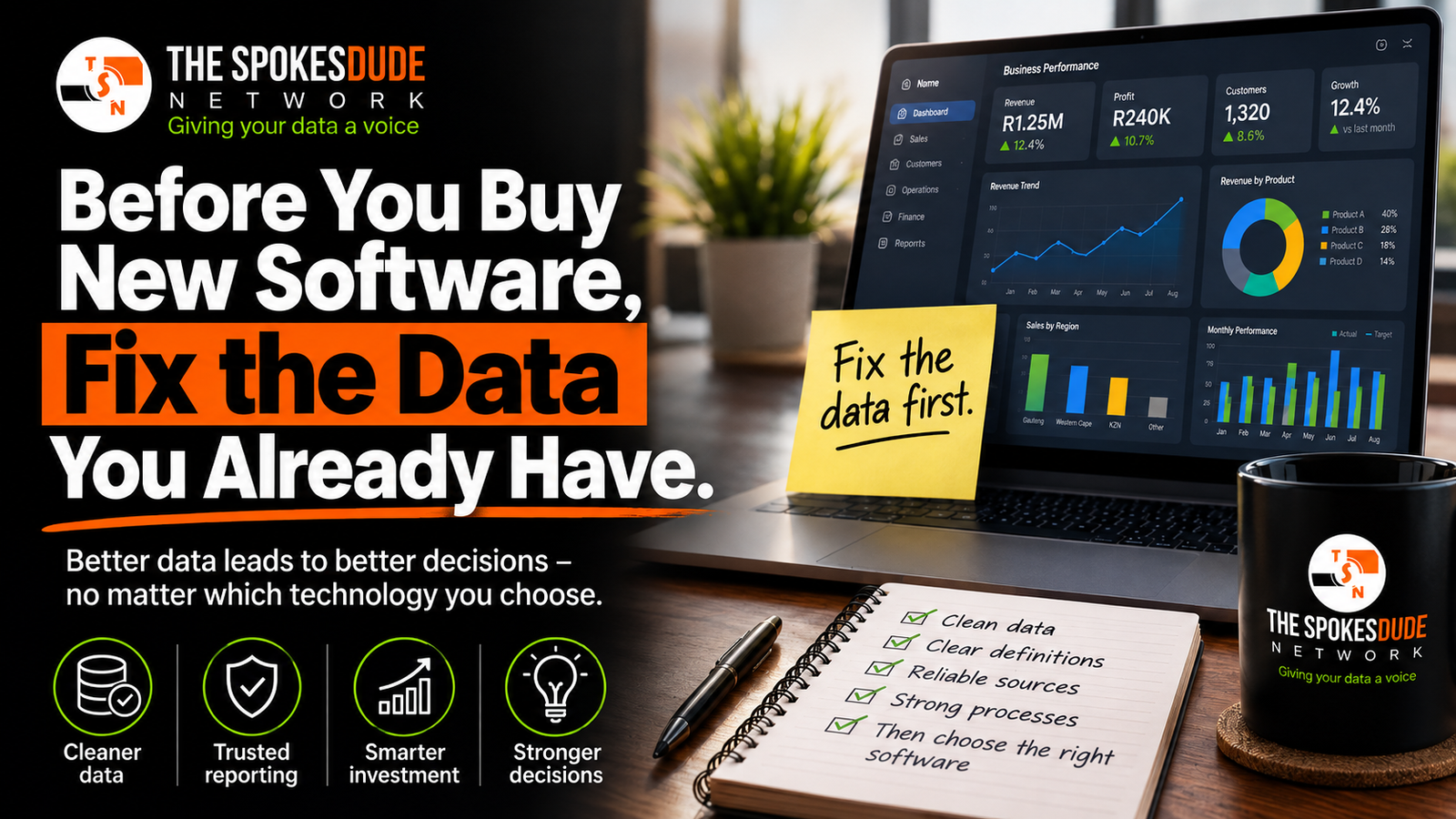
When reporting becomes frustrating, many organisations assume the solution is new software. The spreadsheet is too complicated, the dashboard is unreliable, the CRM does not seem to give the right answers, or the monthly report takes too long to prepare. The natural response is to start looking for a better system.
Sometimes that is exactly what the organisation needs. Technology can remove repetitive work, improve collaboration, strengthen controls and make information easier to access. But new software cannot automatically repair a weak data process, and it cannot transform poor-quality information into reliable business intelligence simply because it sits inside a more expensive platform.
Before buying another system, there is a more important question to ask: Is the data you already have ready for the technology you want to introduce?
New Software Does Not Automatically Mean Better Data
A new system can change where information is stored, how people interact with it and how quickly reports are produced. What it cannot do by itself is decide whether the information being entered is accurate, complete, consistent or meaningful.
If customer records are duplicated today, those duplicates can easily be migrated into the new platform. If departments use different definitions for the same KPI, the new software may simply calculate those conflicting definitions more efficiently. If employees capture information inconsistently, the organisation may end up with a cleaner-looking interface containing exactly the same underlying problems.
This is why some technology projects feel disappointing after implementation. The organisation expected the software to solve a data problem when the deeper issue was the process surrounding the data.
The new platform may work perfectly from a technical perspective while management continues asking why the numbers do not match.
The Migration Problem Nobody Talks About Enough
Moving from one system to another usually requires moving data as well. That is often the moment when years of accumulated data-quality problems suddenly become visible.
Customer names may be spelled in several different ways. Old records may no longer be relevant. Required fields may be missing. Product categories may have changed over time. Duplicate accounts may exist because different employees created records independently. Dates may be stored incorrectly, and some information may no longer have a clear owner.
A migration does not make these problems disappear. In many cases, it forces the organisation to make decisions that should have been made long before the new technology was purchased.
Which record is correct? Which categories should be retained? Which information should be archived? What should happen when mandatory fields are missing? Which historical values need to be standardised?
Cleaning these issues before migration is usually far easier than discovering them after the new system has gone live.
Bad Data Becomes More Dangerous When It Is Automated
Manual reporting is slow, but that slowness sometimes creates opportunities for human beings to notice obvious problems. Someone sees that a total looks unusual, investigates a duplicated row or questions a category that does not make sense.
Automation can remove much of that manual effort, which is one of its greatest advantages. However, automation also means that poor-quality information can move through the reporting process faster and with less human scrutiny.
If a flawed rule is automated, the organisation may repeatedly produce the wrong answer with impressive consistency.
A database can store an incorrect value efficiently. A dashboard can display it beautifully. An automated report can distribute it to senior management every morning.
The technology is doing exactly what it was instructed to do. The problem is that the underlying information or business rule was wrong.
This is why automation should follow understanding. Before a process is automated, the organisation should know what the process is meant to achieve and whether the data supporting it can be trusted.
Start With the Data You Already Have
Before evaluating new technology, it is worth examining the current information environment.
Where does the business's most important data live? Which spreadsheets, systems and databases contain it? Who updates those sources? Which fields are consistently completed, and which are frequently missing? Are there duplicate records? Are important categories standardised? Does everyone use the same definitions?
This exercise does not require an enormous digital transformation programme. Even a focused review of the organisation's most important reporting data can reveal where the real problems are.
Sometimes the findings are surprising.
A company may discover that its main reporting difficulty is caused by one inconsistent customer identifier. Another may find that departments are capturing the same information differently. A third may discover that most of its monthly reporting effort is spent fixing problems that originate in a single source file.
Once the real source of the problem is visible, the organisation can decide whether new software is genuinely required.
Clean Data Before You Move It
If the business does decide to implement a new system, data preparation should become part of the project rather than an afterthought.
The goal should not be to move every historical record simply because it exists. The goal should be to move information that is useful, accurate enough to support the new process and properly understood.
That may require removing duplicates, standardising categories, correcting formats and identifying incomplete records. It may also require deciding which historical data should be archived instead of migrated.
A well-planned migration creates an opportunity to improve the organisation's data foundation. It is one of the few moments when businesses are forced to examine what they have been collecting and whether it still serves a purpose.
The worst approach is to move years of poor-quality information into a new platform and assume it can be cleaned later.
Once bad data becomes embedded inside the new system, correcting it may become more difficult.
Fix the Definitions Before You Fix the Technology
Technology projects often reveal disagreements that were previously hidden inside separate spreadsheets and departmental reports.
Sales may define an active customer differently from finance. Operations may calculate completion using one rule while management expects another. One department may use the date a transaction was created while another reports according to the date it was completed.
Putting everyone onto the same platform does not automatically resolve these differences.
The organisation must decide what each important metric means.
This is where a data dictionary or KPI register becomes valuable. Important measures should have clear definitions, agreed calculation rules and identifiable sources. Where different definitions are legitimately required, those differences should be explicit.
A new reporting platform becomes far more useful when it is built on a shared business language.
Without that agreement, the organisation may spend significant money building a sophisticated system that simply reproduces old arguments in a new interface.
Look at the Process, Not Only the Platform
Sometimes the real problem is not the software or even the data itself. It is the way people work.
Perhaps employees are required to enter the same information into three different places. Perhaps one department emails spreadsheets that another department manually combines every week. Maybe reports require approval from several people because nobody is sure which data source is authoritative. Perhaps important corrections happen through WhatsApp or email and are never reflected in the source system.
These workflow problems can make even good software feel inefficient.
Before replacing a platform, map the process surrounding it. Understand how information enters the organisation, who changes it, where it moves and how it eventually becomes a report.
The objective is to identify unnecessary steps, duplicated work and areas where business rules exist only in people's memories.
Technology should simplify a process that is understood. It should not be used to hide a process that nobody has examined.
Ask What Problem You Are Actually Trying to Solve
Software purchasing decisions become much easier when the business can clearly describe the problem.
“We need a new system” is not a problem statement.
“Our monthly reporting process takes five working days because data from four branches must be manually combined and cleaned” is a much better description.
“Our customer records contain duplicates because there is no unique identifier across our sales channels” is another.
“Our current system cannot provide management with sales performance by product and region without manual exports” is specific enough to evaluate possible solutions.
Once the problem is clear, the business can decide whether it requires better processes, cleaner data, automation, integration or entirely new technology.
Sometimes the answer will still be new software.
But the organisation will know why it is buying it.
Do Not Confuse More Features With More Value
Software vendors naturally compete by offering features.
AI capabilities, automated workflows, dashboards, integrations, notifications, forecasting, mobile applications and dozens of other functions may all appear attractive during a demonstration.
The danger is that organisations start buying features before deciding which capabilities will actually improve their operations.
A system with fifty features is not automatically more valuable than one with ten. If the team only needs five and does not properly use any of them, complexity may become another cost.
For a growing business, the best technology is usually the technology that solves the most important problems without introducing unnecessary operational burden.
That requires discipline.
Instead of asking which platform can do the most, ask which one best supports the process the organisation actually needs.
Software Cannot Replace Data Ownership
Every important dataset should have some form of ownership.
Someone should know what the information represents, who is responsible for maintaining it and what standards apply.
Without ownership, data quality gradually declines.
A new system may temporarily improve the situation because teams pay more attention during implementation. But if nobody is accountable for the quality of the information after launch, the same problems can return.
Customer records become inconsistent. Categories multiply. Required fields are bypassed. Definitions drift. Old information remains active long after it should have been updated.
Technology needs governance.
This does not mean creating bureaucracy around every spreadsheet. It means ensuring that important information has clear responsibility.
The more important the data is to decision-making, the more important ownership becomes.
Sometimes the Best Upgrade Is the Process You Already Have
Not every organisation needs an immediate platform replacement.
A business may discover that significant improvements can be achieved using its existing tools.
Power Query can automate recurring spreadsheet transformations. Shared storage can reduce version confusion. Better validation can improve data capture. A documented reporting process can reduce dependence on one employee. A properly designed data model can improve Power BI reporting without replacing the source systems.
These improvements may not sound as exciting as implementing a completely new platform, but they can deliver substantial value at a fraction of the cost and disruption.
They can also prepare the organisation for a future technology investment.
Once the data is cleaner, the definitions are clearer and the reporting process is understood, selecting and implementing new software becomes much easier.
Know When New Software Really Is Necessary
There are situations where the existing technology genuinely becomes a limitation.
The organisation may have grown beyond the capacity of its current system. Too many users may need simultaneous access. Security requirements may have changed. Manual processes may no longer scale. Integration with other systems may be impossible. Data volumes may have increased significantly, or the business may require functionality that the current tools simply cannot provide.
In these situations, replacing or expanding the technology is reasonable.
The difference is that the decision should be based on evidence.
The business should be able to explain what the current environment cannot do, why that limitation matters and what the new system must achieve.
This changes software selection from a shopping exercise into a business decision.
Better Data Makes Better Technology Possible
Clean, structured and well-understood data makes almost every technology investment more valuable.
Dashboards become more trustworthy because the underlying information is consistent. Automation becomes safer because the rules have been clarified. Artificial intelligence becomes more useful because the data it relies on is more reliable. Integrations become easier because fields and identifiers are understood.
The opposite is also true.
Poor-quality data limits the value of expensive technology.
A modern platform cannot create insight from information the organisation does not trust.
This is why data preparation should not be seen as an inconvenience that happens before the “real” digital project begins.
It is part of the real project.
Fix the Foundation Before You Add Another Floor
Businesses often want technology because they want speed, visibility and growth.
Those are reasonable goals.
But growth built on weak information becomes increasingly difficult to manage. Every additional system, department and process can multiply the inconsistencies that already exist.
The strongest technology environments are usually built on relatively simple foundations: clear data ownership, agreed definitions, consistent capture, documented processes and reliable reporting rules.
Once those foundations exist, technology can do what it does best.
It can automate.
It can connect.
It can scale.
It can make information easier to access.
And it can give decision-makers reliable answers faster.
Technology Should Strengthen the Business, Not Distract From the Problem
At The Spokesdude Network, our approach begins with understanding the information and the business process before deciding what technology should sit on top of it.
Sometimes the answer is a better spreadsheet process. Sometimes it is Power BI. Sometimes it is a database, automation workflow, portal or custom application. In other cases, a new business platform may be exactly what the organisation needs.
The tool should follow the problem.
The goal is not to introduce technology for its own sake. The goal is to create a trusted path from raw information to clear reporting, useful insight and better decisions.
Before signing the contract for another system, take a close look at the information you already have.
Clean it.
Understand it.
Define it.
Document the process around it.
Then decide what technology you actually need.
You may still buy the new software.
But this time, you will be giving it a much better foundation to work with.
Thinking About Replacing Your Reporting or Data Systems?
The Spokesdude Network helps organisations understand and improve the data processes behind their reporting before technology decisions are made.
We help clean and structure data, clarify reporting logic, build reliable data models, automate recurring processes and develop reporting solutions that support real management decisions.
If your organisation is considering new reporting technology but is not yet confident in the information underneath it, we can help you strengthen the foundation first.
Visit thespokesdude.com or contact 081 459 4840 to discuss your data and reporting needs.
The Spokesdude Network — Giving your data a voice.
Write the opening section here.
What this means
Add the practical explanation here.
Next step
Close with clear advice or a useful takeaway.