
Executive summary
Manual reporting may work when a business is small, but as data, teams and reporting demands grow, the process can quickly become slow and unreliable. This article explores seven signs that your organisation may have outgrown manual reporting — and why improving the process can lead to faster, more confident decisions.
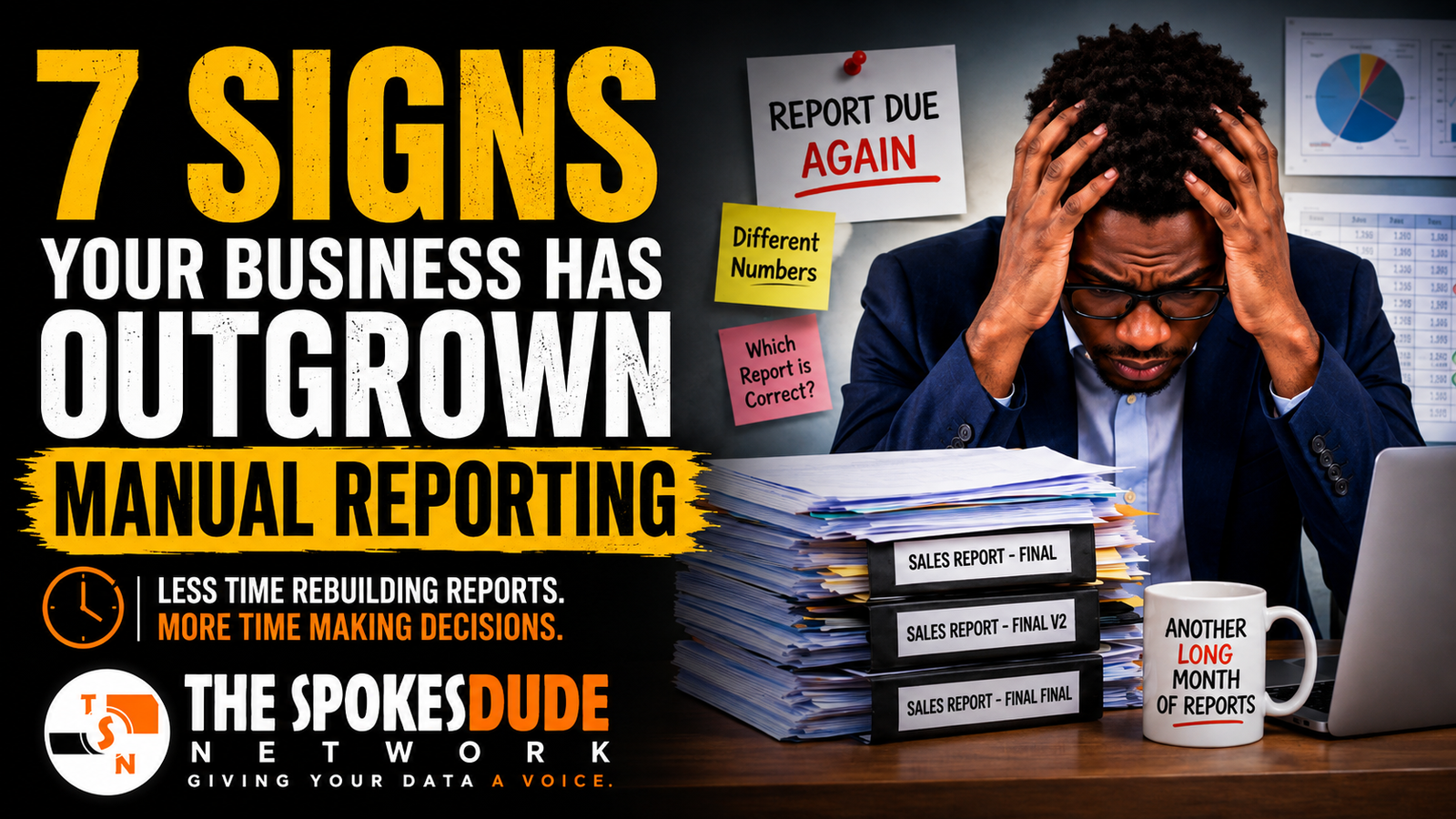
Every business starts somewhere. For many organisations, reporting begins with a spreadsheet. Someone exports sales figures, another person updates customer information, finance supplies a few numbers and, after some copying, checking and formatting, a monthly report appears. At first, this approach can work perfectly well.
The business is small. There are fewer transactions, fewer customers, fewer systems and fewer people requesting reports. One person may be able to understand almost everything that is happening simply by opening a few files. Then the organisation grows. More customers arrive. More employees become involved. New products are introduced. Different departments begin collecting their own information.
Management wants more frequent reports. Clients, funders or investors ask increasingly detailed questions. The reporting process that once took an hour now takes a day. Then two days. Eventually, the organisation may find itself spending more time preparing information than using it. That is usually the point at which the problem is no longer simply about spreadsheets. The business may have outgrown manual reporting.
Manual Reporting Is Not Automatically Bad
There is nothing inherently wrong with preparing reports manually. For a small organisation with limited data and straightforward reporting needs, a manual process may be the simplest and most cost-effective solution. The problem begins when the process no longer matches the scale and complexity of the organisation. Manual reporting becomes dangerous when too many important decisions depend on people repeatedly collecting, copying, cleaning, reconciling and calculating information by hand. The signs often appear gradually.
Sign 1: Reports Take Longer to Prepare Every Month
One of the clearest warning signs is that reporting becomes progressively more time-consuming. A report that once took two hours may begin taking an entire day. Eventually, several employees may be involved in gathering information from different systems before one person can even begin the analysis. This often happens because the reporting process has grown organically. A new customer segment is added, so another worksheet appears. A new branch opens, so another data source must be included. Management asks for an additional KPI, so another formula is created. Individually, these changes may seem small. Over time, however, they create a reporting process that requires more and more manual intervention. The important question is not simply how long the report takes today. It is whether the amount of effort required to produce it is increasing faster than the value being created. If reporting consumes several days every month, the organisation should investigate whether recurring tasks can be standardised, automated or removed entirely.
Sign 2: People Spend More Time Preparing Data Than Analysing It
Reporting should help people think. Instead, many teams spend most of their reporting cycle preparing the numbers. They download files, rename columns, correct dates, remove duplicate records, combine spreadsheets, fix categories, update formulas and check totals. By the time the report is ready, there may be very little time left to ask the questions that actually matter. Why did sales decline? Which products are growing? Which customers are becoming less active? Where are costs increasing? Which programmes are performing well? What should management do differently next month?
If your analysts, managers or administrators spend most of their time preparing data rather than interpreting it, the reporting process is limiting the value the organisation receives from its information. A mature reporting environment should gradually move human effort away from repetitive preparation and toward interpretation, investigation and decision-making.
Sign 3: Different Reports Keep Producing Different Answers
Nothing damages confidence in reporting faster than conflicting numbers. Finance says revenue is one figure. Sales reports another. The operations dashboard shows something slightly different again. Then the meeting stops being about performance. It becomes a debate about whose spreadsheet is correct. Conflicting reports often appear when teams are working from different data extracts, using different formulas or applying different business definitions. One department may define an active customer as someone who purchased within 30 days. Another may use 90 days. One team may exclude cancelled transactions while another includes them. The problem is not necessarily that someone made a mistake. The organisation may simply lack a consistent reporting model. As reporting becomes more important, definitions, calculations and data sources must become standardised. A business cannot confidently make decisions when every important question first requires a debate about which number to believe.
Sign 4: Reporting Depends on One Person
Every organisation seems to have one person who knows “the spreadsheet.” They know which file to download, which tabs to update, which rows to delete and which formulas occasionally break. They also know all the unwritten rules. “This customer must be grouped with that one.” “Do not use that status.” “Those records should always be excluded.” “This formula needs to be copied down manually.” While that employee is available, the reporting process may appear stable. But the dependency becomes obvious when they take leave, resign, become ill or move into another role. If reporting stops because one person is unavailable, the organisation does not have a robust reporting system. It has a key-person dependency. A mature process should ensure that important reporting knowledge is documented, repeatable and transferable. The organisation should own the reporting process, not an individual employee.
Sign 5: Small Changes Create Large Amounts of Work
Management asks a seemingly simple question: “Can we see this by region?” Or: “Can we compare this year with last year?” Or: “Can you show this by customer type?” If answering the question requires someone to manually rebuild a spreadsheet, create new formulas or combine several additional files, the reporting structure may no longer be flexible enough for the organisation's needs. Good reporting systems should make common business questions easier to answer. This does not mean every possible question must already have a dashboard. It means the underlying information should be structured well enough that new analysis does not require starting from the beginning. When every new question becomes a mini data project, the organisation may need to reconsider how its information is being stored, modelled and reported.
Sign 6: Reports Are Already Outdated When Management Receives Them
A report can be perfectly accurate and still be of limited value if it arrives too late. Imagine that management receives July's performance report near the end of August. The numbers may be correct, but the organisation has already spent several weeks operating without understanding what happened. This is one of the hidden costs of manual reporting. When information must pass through multiple people before it can be analysed, the reporting cycle naturally becomes slower. Files must be requested. Exports must be downloaded. Spreadsheets must be combined. Errors must be investigated. Totals must be reconciled. Reports must be formatted. Only then does management see the result. By that stage, some of the decisions the report was supposed to support may already have been made. The value of business information depends partly on timing. The faster an organisation can move from activity to reliable insight, the faster it can respond to problems and opportunities.
Sign 7: Management Wants More Insight Than the Current Process Can Provide
Perhaps the strongest sign of all is that leadership has moved beyond asking, “What happened?” They now want to know: Why did it happen? Which factors contributed most? Which customers are at risk? What happens if the current trend continues? Which areas should receive attention first? These are more sophisticated questions. They often require information from several sources to be connected and analysed together. A collection of independently maintained spreadsheets may struggle to support this level of decision-making consistently. At this stage, the organisation needs more than a monthly reporting routine. It needs a data process that can turn operational information into dependable business intelligence.
Outgrowing Manual Reporting Does Not Mean Abandoning Excel
This distinction matters. Moving away from manual reporting does not necessarily mean removing Excel from the organisation. Excel may continue to play an important role. The difference is that employees should not have to manually rebuild the same reporting process every month. For example, data may still ultimately be presented in an Excel report, but Power Query could automate the preparation process. A database might hold the underlying information while Excel is used for analysis. Power BI might provide management dashboards while Excel remains useful for detailed operational work. The goal is not to eliminate a particular tool. The goal is to reduce unnecessary manual intervention.
What Comes After Manual Reporting?
The next step is usually not to buy the most expensive technology available. It is to understand the current reporting process. Where does the data originate? Who prepares it? What cleaning happens every month? Which calculations are repeated? Which business rules exist only in someone's memory? Which reports are actually used? Which reports could be removed? Which tasks could be automated? Once these questions are understood, the organisation can begin improving the process deliberately. Some organisations may only need better Excel models and Power Query. Others may need centralised databases, automated data pipelines or Power BI dashboards. Growing organisations may eventually need a combination of these technologies. The correct solution depends on the problem.
Automation Should Remove Repetition, Not Understanding
There is often a temptation to automate everything immediately. That can create new problems. A reporting process should first be understood before it is automated. If the organisation does not know why certain records are excluded, what a KPI means or which data source is authoritative, automation will not solve the problem. It may simply automate the confusion. The strongest reporting systems begin with clear business rules. Technology then makes those rules repeatable.
The Real Goal Is Faster, More Reliable Decision-Making
The purpose of improving reporting is not to create a more impressive dashboard. It is not to replace people. And it is not to introduce technology simply because automation sounds modern. The purpose is to shorten the distance between what is happening in the organisation and when decision-makers understand it. A strong reporting process should reduce repetitive work, improve consistency and make trusted information available sooner. That gives employees more time to investigate problems, interpret trends and recommend actions. It also gives leaders more confidence in the decisions they make.
Your Reporting Process Should Grow With Your Business
A reporting method that worked when an organisation had ten customers may not work when it has a thousand. A spreadsheet that was manageable when one person maintained it may become risky when five departments depend on it. This is not necessarily evidence that the original process was poorly designed. Sometimes it simply means the organisation has grown. The important thing is recognising when the process needs to grow with it. If reports take longer every month, employees spend most of their time preparing data, numbers regularly conflict, reporting depends on one person, new questions require extensive manual work and information reaches management too late, your business may be telling you something. You may have outgrown manual reporting. And that can actually be a good problem to have. It may be a sign that the organisation has reached the point where better systems can create significant value.
Is Manual Reporting Slowing Your Business Down?
The Spokesdude Network helps organisations move from repetitive manual reporting toward cleaner, more reliable and repeatable data processes. We work with businesses and organisations to clean and structure data, build reliable data models, develop visual reports and turn information into practical business insight. The objective is simple: less time rebuilding reports and more time understanding what the numbers are saying. Visit thespokesdude.com or contact 081 459 4840 to discuss your reporting and data needs. The Spokesdude Network — Giving your data a voice.