Overview
Most businesses do not suffer from a complete lack of data.They have sales records, customer lists, invoices, spreadsheets, accounting reports, attendance registers, operational systems and monthly performance reports. Some even have sophisticated dashboards.Most businesses do not suffer from a complete lack of data.
Yet, when an important decision must be made, leaders still struggle to answer basic questions confidently:
- Are sales truly improving?
- Which customers or services generate the most value?
- Which customers or services generate the most value?
- Where is the business losing money?
- Why did performance decline this month?
- Which risks require immediate attention?
- What should the organisation do next?
The problem is often not that the business needs more data. The problem is that the data it already has is scattered, inconsistent, incomplete or difficult to interpret.
Data can exist without telling a useful story
A business may collect information every day and still struggle to use it effectively. Sales figures may be stored in one spreadsheet, customer information in another, expenses in an accounting platform and operational activity in several different systems. Different departments may also use different definitions, reporting periods and naming conventions. One report may show that the business served 500 customers, while another shows 470. A customer may be recorded by their full name in one file and by an abbreviation in another. Dates may be captured in different formats, while duplicate records may remain unnoticed. Each file may appear correct when viewed on its own. The difficulty begins when management tries to combine the information and understand the complete picture. Instead of discussing what the numbers mean, teams spend valuable time debating which numbers are correct.
The Business Cost of Unreliable Data
Poor-quality data is not only a technical problem. It is a business risk. When leaders cannot trust their information, decisions are delayed or made using assumptions. Opportunities may be missed because important trends are not identified early enough. Financial problems may remain hidden until they become serious. Staff may also spend hours or days manually combining, checking and correcting reports that should have been available within minutes. Unreliable information can lead to:
- incorrect business decisions;
- missed sales opportunities;
- weak financial control;
- slow reporting;
- poor accountability;
- wasted staff time;
- uncertainty when reporting to investors, funders or partners.
The cost is not limited to money. It also affects time, credibility, confidence and the organisation’s ability to respond quickly.
Data, Information, Insight and Action
These terms are often used interchangeably, but they represent different stages of the decision-making journey.
Data
Data is the raw material. It includes transactions, names, dates, amounts, registrations, activities and other individual records.
Information
Information is data that has been cleaned, organised and placed into a useful structure.
Insight
Insight explains what the information means. It identifies trends, patterns, risks, causes and opportunities.
Action
Action is the decision or response that follows from the insight. For example, a spreadsheet containing monthly sales transactions is data. A report showing sales by product, region and month is information. Discovering that revenue increased while profit declined because a low-margin product dominated sales is insight. Reviewing pricing, supplier costs or the product mix is action. This is the difference between simply possessing numbers and using them to manage a business wisely.
Five Questions Every Business Leader Should Ask
A business does not need to become a technology company to improve how it uses data. It can begin by asking five practical questions
1. Do our reports agree with each other?
When different departments regularly present conflicting figures, the organisation may not have consistent definitions or a trusted reporting process.
2. Can every important number be traced to its source?
A credible report should allow the business to understand where each figure came from and how it was calculated.
3. How long does reporting take?
When monthly reporting requires several days or weeks of manual work, the process may depend too heavily on individuals and disconnected spreadsheets.
4. Do our reports explain why performance changed?
Knowing that sales declined is useful. Understanding why they declined is far more valuable.
5. Does the information help us decide what to do next?
A report should not leave leaders staring at charts without direction. It should help them identify priorities, risks and practical next steps.
What Trusted Business Data Should Provide
Trusted data should give leaders a clear view of what is happening across the organisation. It should show:
- where performance is improving;
- where performance is declining;
- which areas require attention;
- how actual results compare with targets;
- where risks are emerging;
- where opportunities may exist.
Most importantly, trusted data should support decision-making. A useful reporting system should help leaders answer three questions:
What is happening?
The report should clearly show current performance.
Why does it matter?
The information should explain the risks, causes and possible consequences.
What should we do next?
The insight should guide the business towards a practical response. An attractive dashboard that cannot answer these questions has limited business value. The goal should not be to create more charts. The goal should be to create greater clarity.
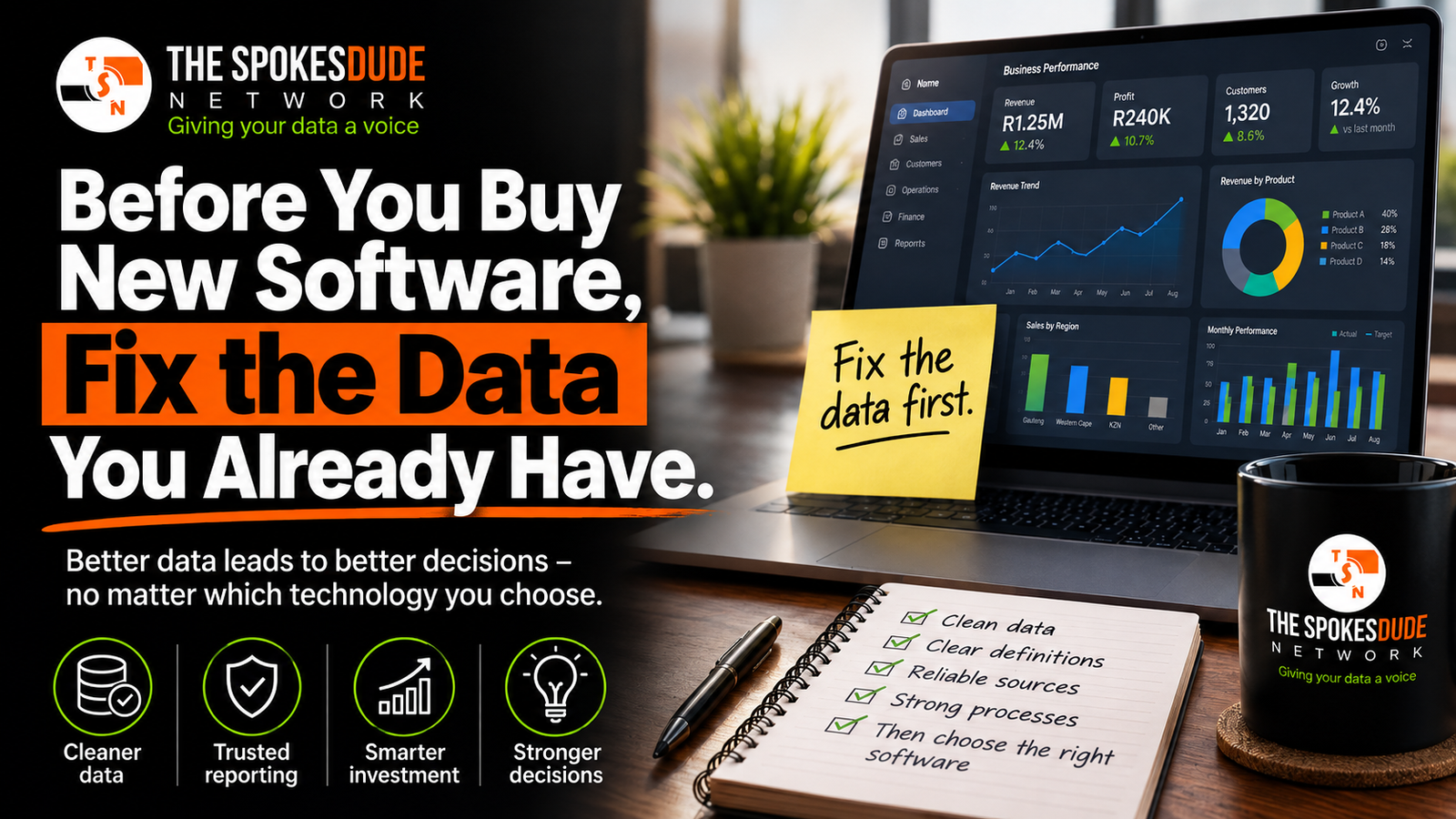
Before Buying Another System, Examine the Data You Already Have
When reporting becomes difficult, the immediate reaction is often to purchase new software. Sometimes a new system is necessary. However, technology alone cannot repair unclear definitions, duplicate records, inconsistent processes or poor data capture. Moving unreliable data into a new platform does not automatically make it reliable. Before investing in another system, a business should first evaluate the condition of its existing information. Ask:
- Is the data complete?
- Are the formats consistent?
- Are duplicate records being managed?
- Do departments use the same definitions?
- Can the information from different systems be connected?
- Are reports produced frequently enough to support decisions?
Improving these foundations can create significant value before a major technology investment is required.
Giving Your Data a Voice
The Spokesdude Network helps organisations turn raw and disconnected information into clean datasets, clear reports and practical business insights. Our work includes:
- data cleaning;
- data modelling;
- Power BI dashboards;
- reporting support;
- business analysis;
- strategic interpretation.
However, the objective is not simply to deliver technical outputs. The objective is to help leaders understand their organisations more clearly and act with greater confidence. Every dataset, report and dashboard should ultimately contribute to better decision-making.
Your Business May Not Need More Data
Many organisations already have valuable information hidden inside spreadsheets, reports, exports and operational systems. That value remains hidden because the information has not yet been cleaned, connected and explained. Before asking how your business can collect more data, ask a different question: Are we making full use of the data we already have? Your business may not need more data. It may simply need its existing data to finally speak.
Ready to Get Clearer Answers From Your Business Data?
The Spokesdude Network helps organisations clean, structure, analyse and visualise their information so leaders can make better-informed decisions.